Artificial intelligence is quickly moving from a cool experiment to a core business tool. In regulated industries like healthcare and finance, this shift brings both massive opportunities and serious risks. AI can accelerate validation and improve documentation, but without governance, it also introduces uncertainty and compliance gaps. This creates a critical challenge for leaders. So, how do you route AI-generated drafts through approvals and compliance checks to keep work both fast and secure? This guide outlines a framework to do just that.
The real question is no longer whether AI will be used in validation. It already is.
The real question is how organizations move from early adoption to governed implementation.
Early AI adoption is often driven by productivity. Teams begin by using AI to summarize documents, draft test scripts, review requirements, generate risk assessments, or analyze large volumes of validation evidence. These use cases are valuable because they reduce time and effort. But as AI becomes embedded into regulated processes, organizations must treat it differently. It can no longer remain an informal helper. It must become a governed capability.
That transition is where many organizations are now.
Your First Steps with AI
In the early adoption phase, AI is usually introduced by individuals or small teams trying to solve immediate problems. A validation analyst may use AI to draft test cases from user requirements. A quality engineer may use AI to compare SOPs against regulatory expectations. A system owner may use AI to summarize change impact. A compliance team may use AI to review deviations, CAPAs, or audit findings.
These are practical use cases, and they often deliver immediate value.
For example, instead of manually reading a 100-page requirements document and drafting validation scenarios from scratch, a validation team can use AI to identify functional areas, suggest test coverage, and highlight missing controls. The human still reviews and approves the output, but the first draft is created faster.
This type of AI adoption is useful, but it is also limited. Early adoption usually lacks formal controls. Prompts are not standardized. Outputs are not always retained. Human review may not be documented. AI-generated recommendations may be copied into validation documents without clear attribution. Different users may get different answers from the same model depending on wording, configuration, or context.
That is acceptable for experimentation. It is not acceptable for governed validation.
Why You Can't Skip Governance in Validation
Validation is not just documentation. It is evidence that a system, process, application, or controlled workflow performs as intended and meets business, regulatory, and quality requirements.
In a regulated environment, validation must answer several core questions:
- What requirement was tested?
- What risk was addressed?
- What evidence supports the result?
- Who reviewed and approved the outcome?
- What changed, when, and why?
- Was the process followed consistently?
- Can the organization defend the decision during an audit?
AI does not remove these requirements. It increases the need to manage them carefully.
When AI is used in validation, organizations must be able to explain where AI was used, what data was provided to it, what output it generated, who reviewed the output, whether the output was accepted or modified, and how final approval was reached.
The key principle is simple: AI may assist validation, but it should not become an uncontrolled validation authority.
When AI Assistance Isn't Enough
The move from early adoption to governed implementation requires a shift in mindset.
In early adoption, the focus is: “Can AI help us move faster?”
In governed implementation, the focus becomes: “Can AI help us move faster while maintaining control, traceability, compliance, and audit readiness?”
That shift changes how AI must be implemented.
Organizations need approved use cases, role-based access, controlled prompts, documented review steps, approval workflows, model usage logs, data protection rules, and evidence capture. AI outputs must be treated as inputs into a controlled process, not as final validated conclusions.
For example, if AI drafts a validation test script, the process should capture the source requirements, the prompt or instruction used, the generated test script, the reviewer’s changes, the approval decision, and the final approved version. This creates a defensible validation trail.
Without that governance layer, AI can improve productivity while weakening compliance.
Human Oversight: The Non-Negotiable Rule
Many organizations initially describe their AI governance model as “human in the loop.” That is useful, but it is not enough for validation.
Human in the loop means a person reviews the AI output. Human in command means the process is designed so that humans remain accountable for decisions, approvals, exceptions, and final validation outcomes.
This distinction matters.
AI can suggest a risk level, but a qualified person must approve the risk assessment. AI can generate test cases, but validation owners must confirm coverage. AI can compare documents, but quality teams must decide whether the differences are material. AI can summarize evidence, but the final validation conclusion must remain controlled and approved.
In governed validation, AI supports the process. It does not own the process.
This is where workflow automation becomes critical. AI alone does not provide governance. A governed workflow ensures that AI-generated content moves through defined review, approval, escalation, and audit steps.
The Unique Failure Modes of AI Content
One of the biggest challenges with AI-generated content is that it often looks deceptively clean. Unlike human-written drafts that might have typos or awkward phrasing, AI output is typically well-formatted and grammatically perfect. This polish can create a false sense of security, leading reviewers to approve content that contains hidden flaws. AI-generated code, for instance, might include calls to non-existent APIs or contain subtle logic errors that only surface under specific conditions. In validation documents, this could manifest as a perfectly worded risk assessment that completely misses a critical control or a test script that fails to cover the full scope of a requirement.
These failures are unique because they don't stem from carelessness, but from a lack of genuine understanding. An AI model doesn't comprehend the system-wide impact of a change or the regulatory intent behind a requirement. It simply generates content based on patterns in its training data. Because AI fails in these new and unexpected ways, reviewers need to adopt specialized techniques. A simple once-over is no longer enough; you need a structured approach to probe for these hidden issues and ensure the output is not just well-written, but correct and contextually appropriate for your regulated environment.
Common Mistakes Reviewers Make
When reviewing AI-generated content, it's easy to fall into traps that compromise validation integrity. A frequent mistake is trusting the AI to validate its own work—for example, using one AI prompt to generate a test plan and another to summarize the results. This creates a closed loop where errors are perpetuated, not caught. Another common pitfall is focusing on style over substance. Reviewers get distracted by the polished formatting and fail to notice that the core logic is flawed. This leads to approving content simply because it “looks right” rather than because it has been rigorously checked for correctness.
Other mistakes include skipping critical checks, like security reviews or cross-referencing against source documents, because the AI output appears complete. Perhaps the most significant error is reviewing in a vacuum, without the original requirements readily available. To counter these issues, you need a process that enforces rigor. A governed workflow ensures that reviewers are always working from the source of truth, that checklists are completed, and that approvals are tied to tangible evidence. This transforms the review from a subjective check into a structured, defensible validation activity, which is essential for maintaining compliance.
Putting AI to Work in Validation
AI can support validation in many practical ways when implemented within a governed process.
Streamline Requirements Analysis
AI can review business requirements, user requirements, functional specifications, and design documents to identify missing details, ambiguity, duplicate requirements, or potential test scenarios.
For example, if a requirement says, “The system should notify users when a task is overdue,” AI can identify missing validation details such as notification timing, recipient rules, retry behavior, escalation logic, and audit logging expectations.
The value is not that AI writes the final requirement. The value is that AI helps reviewers find gaps earlier.
Using AI as an Intelligent Approval Agent
AI can also act as a preliminary gatekeeper in your approval processes. Think of it as an intelligent agent that performs the initial review of a request, checking it against company policies, regulatory rules, or historical data. For example, when a change control request is submitted for a validated system, an AI agent can automatically verify that all required documentation is attached, the impact assessment is complete, and the proposed change doesn't conflict with established system configurations. It can then suggest an action—like approve, deny, or escalate to a specific subject matter expert—based on these predefined rules, saving your team valuable time on routine checks.
This capability is most powerful when integrated directly into your business processes. An AI-powered workflow automation platform ensures the AI’s suggestion is just one step in a larger, governed sequence, not the final decision. The platform can take the AI's recommendation and automatically route the entire package—including the AI's analysis—to the correct human approver for the final sign-off. This not only accelerates the process by handling the initial legwork but also provides a complete, unchangeable audit trail. This record shows both the AI's input and the final human approval, which is absolutely essential for maintaining compliance and accountability during an audit.
A Smarter Way to Assess Risk
AI can support risk-based validation by analyzing requirements, process impact, data criticality, user roles, integration points, and compliance relevance.
For example, a workflow that approves GMP batch release documentation carries higher validation risk than a workflow that routes an internal facilities request. AI can help classify the risk factors, but the final risk rating must be reviewed and approved.
Automating Test Script Generation
AI can generate draft test scripts from requirements, process diagrams, configuration data, or workflow definitions. This can reduce the manual effort required to create validation test cases.
For example, in a FlowWright process, AI could analyze steps, decisions, approvals, task assignments, due dates, escalations, integrations, and exception paths. It could then suggest test cases for normal flow, rejection flow, timeout flow, reassignment flow, and audit trail verification.
The final test script should still be reviewed, versioned, approved, and executed under controlled validation procedures.
Speed Up Your Evidence Review
AI can help review screenshots, logs, execution results, completed forms, audit trails, and test evidence. It can identify missing attachments, inconsistent timestamps, mismatched expected and actual results, or incomplete reviewer comments.
This is a strong use case because validation evidence review is often time-consuming and repetitive. AI can act as a second-level assistant that highlights potential issues for human review.
Generating AI Summaries for Faster Decisions
Validation processes are famous for generating long documents—think change requests, deviation reports, or policy updates. Instead of asking reviewers to read every word from the start, AI can create a short, easy-to-read summary of the main points. This gives your team a quick overview before they get into the details. It's a simple change that makes a big difference. By presenting the key information upfront, AI reduces the mental effort required from reviewers, helping them focus on what matters and provide better feedback faster. When policies and changes are approved more quickly, your organization can react to new challenges or risks sooner. When this capability is part of a governed workflow, you also maintain clear records of who reviewed the summary and the full document, ensuring a complete audit trail.
Simplifying Change Impact Analysis
When a system changes, validation teams must determine what needs to be retested. AI can help analyze release notes, configuration changes, code changes, workflow changes, form changes, integration updates, and security changes.
For example, if a workflow approval step is modified to include a new role-based approval rule, AI can suggest impacted requirements, test cases, SOPs, training materials, and regression tests.
The organization still needs a controlled change process to approve the final impact assessment.
Automate Document Comparison
AI can compare versions of validation documents, SOPs, requirements, test scripts, and reports. It can identify meaningful changes and distinguish between formatting changes and content changes.
For regulated teams, this can reduce review burden while improving consistency.
What Happens When AI Goes Unchecked?
AI can introduce several risks if used without proper controls.
The first risk is hallucination. AI may generate content that sounds correct but is not supported by actual system behavior, requirements, or evidence.
The second risk is inconsistency. Different prompts may produce different validation outputs, making standardization difficult.
The third risk is loss of traceability. If AI-generated content is copied into validation documentation without retaining source context, the organization may not be able to explain how the conclusion was reached.
The fourth risk is data exposure. Validation documents may contain confidential product, patient, manufacturing, financial, or operational data. AI usage must respect data classification and security rules.
The fifth risk is overreliance. Teams may begin trusting AI-generated validation conclusions without proper review.
These risks are manageable, but only when AI is implemented through governed workflows.
The Rise of AI-Generated Code in Enterprises
Beyond generating documents and test scripts, AI is now writing software code. Development teams are using AI copilots to accelerate their work, and the speed improvements are impressive. However, this speed introduces new risks because the code isn't always reviewed with the same rigor as human-written code. When AI-generated code is integrated into applications without thorough oversight, it can create significant problems with security, performance, and regulatory compliance. The temptation to move faster can lead teams to skip critical review steps, treating the AI's output as a finished product instead of a first draft that requires human validation and accountability.
Increased Speed vs. Increased Bugs
The trade-off for speed can be a steep decline in quality. Some studies show that while AI can accelerate development by as much as 40%, the rate of defects can climb by 25% when proper reviews are not in place. A 25% increase in bugs isn't just a minor inconvenience; it represents a major threat to system stability and reliability. For regulated enterprises, this can translate into failed validation, compliance gaps, and costly remediation efforts that erase any initial time savings. This highlights a critical point: productivity gains are meaningless if the final product is unreliable or fails during an audit.
The Hidden Dangers of Insecure Code
Perhaps the most alarming risk is the introduction of security vulnerabilities. One analysis found that nearly half of all AI-generated code contained potential security problems. These aren't just simple bugs; they are flaws that could be exploited to compromise data, disrupt operations, or gain unauthorized access to sensitive systems. In industries where data integrity and security are non-negotiable, blindly trusting AI to write code is a dangerous gamble. It reinforces the need for a governed process where every piece of code, regardless of its origin, is subject to strict review, testing, and human approval before it ever reaches a production environment.
A Blueprint for Governed AI Implementation
A governed AI validation framework should include several key controls.
First, define approved AI use cases. Not every validation activity should use AI. Organizations should identify where AI is allowed, where it is restricted, and where it is prohibited.
Second, standardize prompts and instructions. If AI is used to generate test scripts or risk assessments, the prompts should be controlled, versioned, and approved.
Third, capture AI inputs and outputs. The validation record should show what information was provided to AI and what response was generated.
Fourth, require human review and approval. AI-generated outputs should route through qualified reviewers before becoming part of the official validation package.
Fifth, maintain audit trails. Every AI-assisted validation step should preserve who initiated it, when it ran, what it produced, who reviewed it, and what decision was made.
Sixth, manage security. AI access should be role-based and aligned with enterprise security rules.
Seventh, monitor performance. Organizations should track AI usefulness, rejection rates, correction patterns, and recurring quality issues.
For example, if AI-generated test scripts are frequently modified by reviewers, that feedback should be used to improve instructions, templates, and governance rules.
A Framework for Reviewing AI-Generated Content
Simply having a "human in the loop" isn't a strategy; it's a starting point. To truly govern AI in validation, you need a repeatable framework for reviewing its output. This ensures that every piece of AI-generated content is accurate, traceable, and secure before it becomes part of an official record. A structured review process moves your team from ad-hoc checks to a defensible, audit-ready system. It’s about creating a clear path from AI generation to final approval, where every step is documented and every decision is accounted for. This is where a powerful workflow automation platform becomes your best asset, turning your governance policies into an executable process that guarantees consistency and control.
Before You Begin: Pre-Review Actions
Before a review even starts, you need to set the stage for success. The first rule is that all "AI-generated outputs should route through qualified reviewers before becoming part of the official validation package." This isn't a task for just anyone; it requires subject matter experts who can spot inaccuracies. Your process must also ensure the validation record is complete. It should clearly show what information was provided to the AI and what response was generated. Think of it as creating a receipt for every AI interaction. This creates an unbroken chain of evidence, ensuring that "every AI-assisted validation step should preserve who initiated it, when it ran, what it produced, who reviewed it, and what decision was made."
A Six-Layer Checklist for a Comprehensive Review
A thorough review goes beyond a simple thumbs-up. While "AI may assist validation, it should not become an uncontrolled validation authority." To maintain control, your review process should confirm several key points. When you explain your process to an auditor, you must be able to detail where AI was used, what data was provided to it, what output it generated, who reviewed the output, whether it was accepted or modified, and how the final approval was reached. This checklist ensures that human accountability remains at the center of the process. By embedding these checks into an automated workflow, you guarantee that no step is skipped and that a complete audit trail is captured automatically for every single item.
Conducting a Detailed Security Review
Using AI without proper controls can introduce significant security risks that you can't afford to ignore. The most well-known risk is "hallucination," where the AI generates content that sounds plausible but is factually incorrect or unsupported by your system's actual behavior. Another major concern is data exposure. As the source material points out, "validation documents may contain confidential product, patient, manufacturing, financial, or operational data." Sending this information to an external, unsecured AI model is a critical security failure. Your review process must include a checkpoint to ensure that sensitive data is handled according to your company's security policies and that the AI's output doesn't inadvertently expose confidential information.
Establishing Ethical and Legal Guardrails
Beyond technical accuracy and security, using AI in a regulated space requires clear ethical and legal guardrails. These rules aren't just about following the law; they're about building trust with customers, partners, and regulators. Your organization is accountable for how its AI systems are used, especially when they handle personal or sensitive data. Establishing these guardrails from the outset protects your business and ensures your AI strategy is sustainable. It involves defining clear policies, respecting individual rights, and holding your technology partners to the same high standards you set for yourself. This proactive approach to governance is fundamental to responsible innovation.
Managing Consent and Data Privacy
Your first step is to create a clear policy for AI usage. You should explicitly "identify where AI is allowed, where it is restricted, and where it is prohibited" within your organization. This isn't a one-size-fits-all decision; the rules may differ for your R&D, manufacturing, and finance departments. Once you have a policy, you need to enforce it. Access to AI tools should be managed carefully, ensuring that "AI access should be role-based and aligned with enterprise security rules." This prevents unauthorized use and ensures that employees only use AI for approved tasks, protecting sensitive company and customer data from being processed by inappropriate models. This is a core component of a well-governed digital transformation strategy.
Upholding Individual Data Rights
Data privacy laws are evolving to address the unique challenges of AI. It's crucial to understand that individuals have specific rights when it comes to automated decision-making. For instance, in many jurisdictions, people "have the right to say no to AI making certain big decisions about you (like for housing or jobs) and the right to have your data deleted from AI models." Your organization must have processes in place to honor these rights. This includes being able to track whose data is used in which models and having a clear procedure for handling deletion requests. Building your AI tools within a process management framework makes it easier to manage these requests and document compliance, ensuring you can respond to data rights inquiries quickly and accurately.
Evaluating AI Vendor Responsibilities
You are also responsible for the actions of your AI vendors. Before integrating any third-party AI tool, you must evaluate their data handling and privacy policies. A key question to ask is whether they use your data to train their models. Reputable vendors will be transparent about this. Legally, "companies must state in their privacy notices if they use personal data to train AI." Furthermore, if a vendor wants to use your existing data for a new AI purpose, they should get your explicit consent or provide a clear way to opt out. Vetting your vendors on these points is a critical due diligence step that protects your intellectual property and ensures you don't unknowingly violate data privacy regulations.
Training AI for a Consistent Company Voice
Once you have the governance and security frameworks in place, you can focus on the quality of the AI's output. For tasks like generating documentation, reports, or communications, you want the content to sound like it came from your organization. The best way to achieve this is to "train your AI on your firm's specific writing style." By providing it with examples of your best documents, style guides, and approved terminology, you can guide it to produce content that is consistent with your brand voice. This reduces the amount of time reviewers have to spend editing for tone and style, allowing them to focus on factual accuracy. This is especially powerful when using an integrated tool like FlowWright's AI Copilot, which can be guided to build processes and forms that align with your established standards.
How FlowWright Supports Governed AI
Governed AI validation requires more than an AI model. It requires orchestration.
This is where FlowWright fits naturally.
FlowWright can provide the process layer that controls how AI is used in validation. AI can be embedded into validation workflows as an assistant, while FlowWright manages routing, approvals, audit trails, exceptions, roles, forms, documents, tasks, escalations, and reporting.
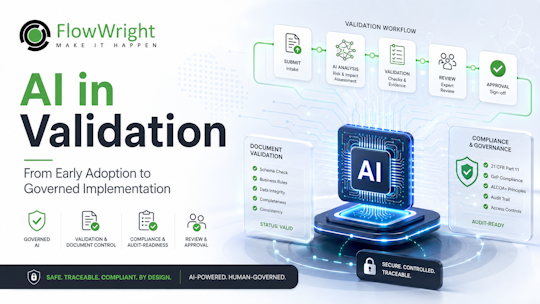
For example, a validation workflow in FlowWright could follow this pattern:
- A system change is submitted.
- FlowWright routes the change for initial review.
- AI analyzes the change and suggests impacted requirements, risks, and test cases.
- A validation analyst reviews and modifies the AI output.
- Quality approval is required before the validation plan is finalized.
- Test execution tasks are assigned.
- Evidence is collected through controlled forms and documents.
- AI reviews evidence for completeness.
- Human reviewers approve or reject the package.
- FlowWright maintains the audit trail and final validation history.
This model keeps AI useful but controlled. The AI performs work, but FlowWright governs the process.
That distinction is important. In regulated environments, the enterprise does not need uncontrolled AI automation. It needs controlled AI-assisted execution.
Is Your AI Ready for an Audit?
Audit readiness must be designed into AI validation from the beginning.
Organizations should assume that auditors will eventually ask:
- Where was AI used?
- What did AI generate?
- Was the AI output reviewed?
- Who approved it?
- What controls prevented incorrect AI output from becoming final?
- How was data protected?
- Can the organization reproduce or explain the decision path?
A governed implementation makes these questions easier to answer.
Instead of saying, “A user used AI to help write this,” the organization can show a complete process history. It can show the change request, AI-generated draft, reviewer edits, approval steps, test evidence, exceptions, signatures, and final release decision.
That is the difference between AI experimentation and AI governance.
Advanced Strategies for AI Quality Assurance
As AI becomes a standard part of your validation toolkit, your quality assurance methods need to mature alongside it. Basic human review is a great start, but truly governed AI requires more sophisticated strategies to ensure reliability, consistency, and audit readiness. It’s about building a resilient system where AI-generated content is not just checked, but actively challenged and measured. This approach helps you move beyond simply using AI to proactively managing its quality, turning a potential risk into a controlled, defensible asset for your organization.
Using Adversarial AI for Peer Review
One powerful technique is to use AI as a "peer reviewer" to challenge its own outputs. Think of it as a built-in stress test. For example, you could task one AI instance with generating a test script and another with finding flaws or edge cases in that script. This adversarial process can uncover weaknesses that a single pass might miss. However, the ultimate decision-making authority must always rest with a person. As a core principle, AI can suggest a risk level, but a qualified person must approve the risk assessment. AI can summarize evidence, but the final validation conclusion must remain controlled and approved by your quality teams. This ensures that AI serves as an intelligent assistant, not an unaccountable decision-maker.
Measuring Quality with Advanced Metrics
You can't improve what you don't measure. To ensure AI is truly adding value, you need to track its performance with specific metrics. Go beyond simple productivity gains and monitor things like AI usefulness, rejection rates of AI-generated content, and patterns in the corrections made by human reviewers. For instance, if your validation owners frequently modify AI-generated test scripts, that’s not a failure—it’s critical feedback. This data should be used to improve the prompts, templates, and governance rules that guide the AI. A high correction rate might indicate that your instructions are ambiguous or that the AI model needs more context, allowing you to fine-tune the process for better results over time.
Why You Can't Blindly Trust AI-Generated Tests
It’s tempting to accept AI-generated content at face value, especially when it looks professional and sounds correct. This is a significant risk. AI models can "hallucinate," producing content that is plausible but factually wrong or unsupported by your actual system requirements. Another major risk is inconsistency. Using slightly different prompts can produce wildly different outputs, making it difficult to standardize your validation process. This is why you can't blindly trust AI-generated tests. Every output must be treated as a draft that requires rigorous human verification against the source requirements and evidence to ensure it aligns with reality, not just a convincing-sounding suggestion.
What's Next for AI in Validation?
AI will continue to evolve. Models will become better at analyzing documents, interpreting process logic, reviewing evidence, generating test scenarios, and identifying compliance risks. But the future of validation will not be AI replacing quality teams. It will be AI working inside governed systems where people remain accountable and processes remain auditable.
The winning organizations will not be the ones that use AI the fastest. They will be the ones that use AI responsibly, with the right balance of speed, control, traceability, and governance.
AI can reduce validation effort. It can improve consistency. It can help identify gaps earlier. It can accelerate documentation. It can support better risk-based decisions.
But validation still requires discipline.
AI must be implemented as part of a controlled operating model, not as an informal shortcut. That means approved use cases, governed workflows, human accountability, audit trails, security, and continuous oversight.
AI in validation is moving from early adoption to governed implementation. This is the right evolution.
Early adoption proved that AI can help validation teams work faster. Governed implementation will prove that AI can help them work better, safer, and with greater confidence.
For regulated enterprises, the future is not uncontrolled automation. It is governed intelligence.
And that is exactly where AI belongs: embedded inside controlled workflows, assisting skilled professionals, strengthening validation quality, and producing audit-ready evidence at every step.
Frequently Asked Questions
Is it safe to use AI for validation in regulated industries? Yes, but only when you have strong governance in place. Using AI without controls is risky because it can introduce errors, inconsistencies, and security vulnerabilities. The key is to embed AI into a structured workflow that requires human review and approval. This way, AI assists your team by handling tasks like drafting documents or analyzing data, but qualified people always make the final, accountable decisions.
What's the difference between "human in the loop" and "human in command"? "Human in the loop" simply means a person reviews what the AI creates. "Human in command" is a more robust approach where the entire process is designed to keep humans accountable for the final outcome. In this model, AI acts as a capable assistant, but people are responsible for approvals, exceptions, and the final validation decision. For regulated work, "human in command" is the standard you should aim for.
My team is already using AI to speed things up. Why do we need a formal process? Early, informal AI use is great for productivity, but it's not sustainable or defensible for regulated validation. Without a formal process, you can't prove to an auditor how a decision was made, ensure consistency, or protect sensitive data. A governed workflow creates a complete, unchangeable audit trail that shows who did what, when, and why, which is essential for maintaining compliance.
Can AI replace my quality assurance team? No, AI is a tool to support your quality team, not replace it. It can automate repetitive tasks like generating first drafts of test scripts or reviewing evidence for completeness, which frees up your experts to focus on more critical analysis. The goal is to combine AI's speed with your team's expertise and judgment, which makes the entire validation process faster and more thorough.
How can I prevent AI from making mistakes like "hallucinations" in our validation documents? You can't completely prevent AI from making mistakes, but you can build a process to catch them. The best defense is a mandatory, structured human review for all AI-generated content. Your process should require reviewers to check the AI's output against original source documents, like requirements or system specifications. This ensures the content is not just well-written but also factually correct and contextually appropriate for your specific needs.
Key Takeaways
- Move from AI assistance to AI governance: Using AI to draft documents is a good first step, but regulated industries require a formal framework. This means shifting from informal experiments to implementing AI within controlled workflows that ensure traceability, human accountability, and audit readiness.
- Keep humans in command of the process: AI can assist with tasks like generating test scripts or summarizing evidence, but it cannot be the final authority. A "human in command" approach is essential, where qualified experts are responsible for reviewing, modifying, and approving all AI-generated content to catch hidden errors and maintain compliance.
- Use a structured workflow to manage AI risks: Unchecked AI introduces risks like factual errors, inconsistent outputs, and data security breaches. A governed implementation, supported by a workflow automation platform, mitigates these issues by standardizing prompts, documenting every step, and enforcing security rules, making AI a reliable and defensible tool.