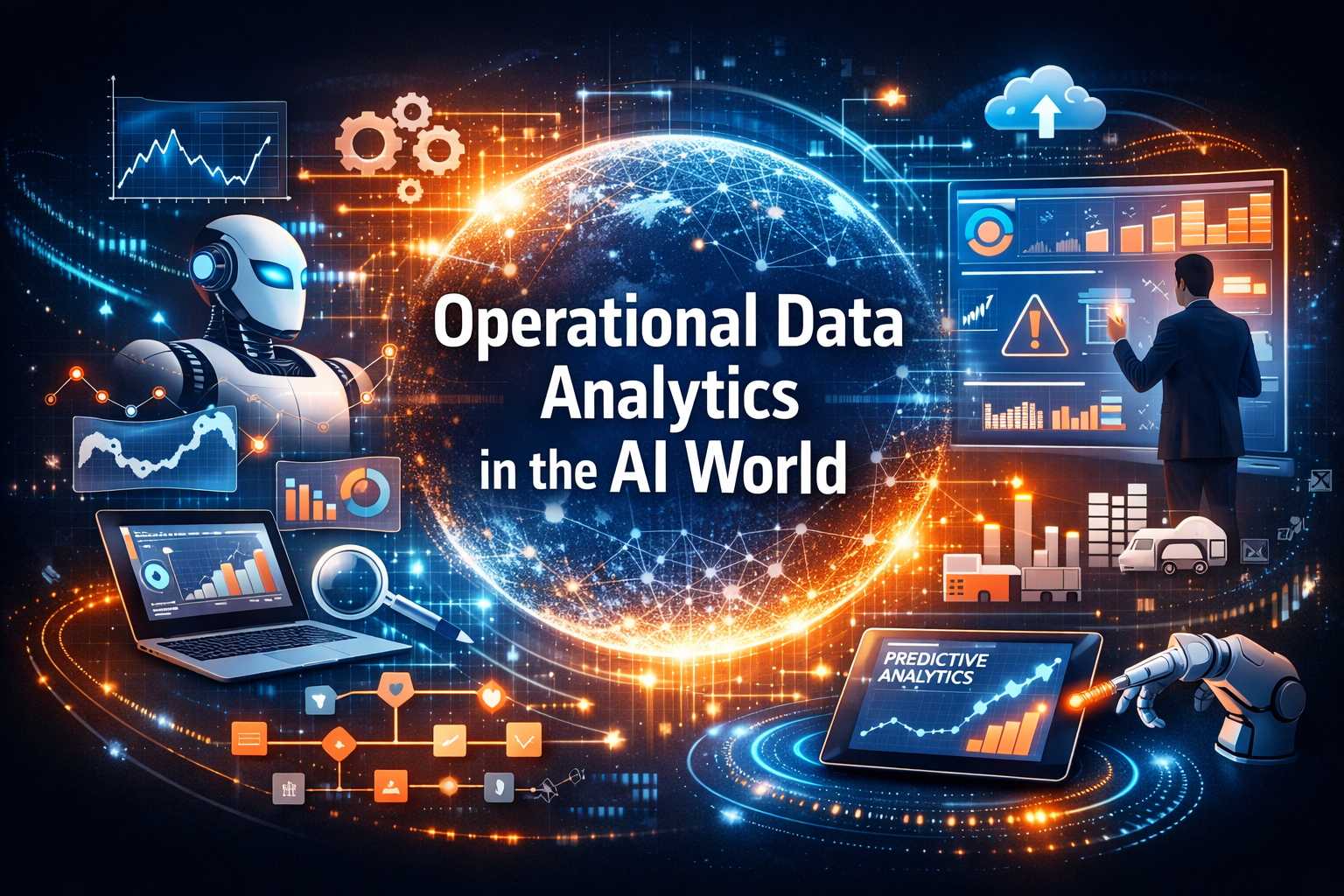
In the last decade, data analytics has moved from the back office to the center of business execution. What was once a reporting function used mainly to understand historical performance has now become a real-time operational capability that shapes decisions as work is happening. In the AI world, operational data analytics is no longer about simply collecting dashboards and reviewing metrics at the end of the month. It is about using live business data, process context, machine intelligence, and predictive insight to continuously guide how organizations operate.
This shift is significant. Businesses are no longer satisfied with knowing what happened. They want to know what is happening now, what is likely to happen next, and what action should be taken immediately. AI has amplified this expectation. It has made operational analytics more dynamic, more intelligent, and more embedded inside day-to-day workflows than ever before.
Operational data analytics in the AI world is the discipline of analyzing business, system, and process data in motion so organizations can make smarter operational decisions in real time. It connects data from workflows, applications, users, devices, and transactions, then applies analytics and AI models to detect patterns, predict outcomes, recommend actions, and automate decisions. This is not analytics as a static afterthought. This is analytics as an active participant in operations.
From historical reporting to intelligent operations
Traditional analytics has largely focused on descriptive reporting. Organizations built data warehouses, created reports, and tracked KPIs such as sales, cycle times, defect counts, or customer service volume. Those capabilities still matter, but they are not enough in an AI-driven enterprise.
Modern operations generate continuous streams of data. Every form submission, system event, workflow transition, customer interaction, API request, approval decision, and document update produces signals. Hidden in those signals are indicators of operational health, risk, bottlenecks, anomalies, and opportunities for improvement.
AI changes the role of analytics by allowing systems to interpret those signals faster and with greater sophistication. Instead of waiting for an analyst to review a report and identify a problem, AI models can detect deviations in real time. Instead of relying only on thresholds, systems can learn patterns and spot issues that do not fit normal behavior. Instead of presenting raw charts to managers, analytics platforms can generate contextual recommendations and trigger workflows automatically.
This is the core transformation: analytics is moving from passive visibility to active operational intelligence.
What makes operational analytics different
Operational data analytics is different from general business intelligence because it is tightly connected to execution. It focuses on live operations, not just strategic review. It works at the speed of the business. It supports decisions that affect transactions, customers, employees, and processes immediately.
A traditional report might show that invoice processing took seven days last quarter. Operational analytics asks which invoices are likely to miss SLA today, which approvers are causing delays, what exception pattern is increasing rework, and what automation step can correct it now.
A traditional report might show customer churn increasing over three months. Operational analytics asks which active customers currently show churn signals, what interaction pattern predicts dropout, and which retention process should be launched automatically.
In the AI world, operational analytics is most valuable when it is embedded inside systems of work. It is not enough to have a dashboard on the side. The analytics must inform the workflow itself. That means the analytics engine, AI models, business rules, and process automation platform need to work together.
The role of AI in operational data analytics
AI brings several important layers of value to operational analytics.
First, it improves pattern recognition. AI can identify relationships across large volumes of structured and unstructured data that would be difficult for humans to detect manually. This includes process delays, fraud indicators, document classification patterns, user behavior anomalies, and prediction of case outcomes.
Second, it enables prediction. Operational analytics becomes far more powerful when it can estimate future events. AI models can predict late payments, process failures, SLA breaches, customer escalation risk, inventory shortages, or compliance issues before they occur. Prediction turns analytics into a proactive capability.
Third, AI supports prescriptive decisions. Once a likely outcome is identified, the system can recommend or even initiate the next best action. For example, if a service case is likely to breach SLA, the platform can escalate automatically. If a document appears incomplete, the workflow can route it back for correction. If a transaction looks suspicious, the system can pause it and require additional review.
Fourth, AI helps interpret unstructured information. Operational decisions are often tied to emails, documents, scanned files, contracts, forms, comments, and chat conversations. AI models can extract meaning from this content, convert it into operational signals, and make it available for analytics and workflow decisions.
Fifth, AI makes analytics more accessible. Users no longer need to be expert analysts to gain insight. Natural language querying, AI-generated summaries, automated anomaly descriptions, and recommendation engines allow business users to understand operations quickly and take action with confidence.
The data sources that matter
Operational data analytics in the AI world depends on combining multiple kinds of data. Transactional data is only one piece. Real value comes when organizations bring together process data, application data, user activity, document content, event logs, audit trails, and external signals.
Process data is especially important because it reveals how work actually moves through the organization. It shows where tasks wait, who approves what, how exceptions are handled, what steps are skipped, where rework occurs, and which process paths lead to the best or worst outcomes.
Application data adds business context. ERP, CRM, HR, finance, support, and industry-specific systems contain the records that operations depend on. User activity logs reveal behavior. Document repositories contain evidence and supporting information. API interactions expose system-level patterns. IoT or machine signals may add real-time status in industrial or field operations.
When AI is applied across these combined data streams, operational analytics becomes much more accurate and actionable. The system no longer sees isolated events. It sees a connected operational picture.
Real-time analytics inside workflows
One of the most important developments in the AI world is the movement of analytics directly into workflow engines and operational platforms. This is where the highest value is created.
Consider a document approval process. Operational analytics can track average approval time, rejection rate, reviewer workload, policy violations, and document categories. AI can go further by analyzing document content, predicting whether approval is likely, flagging missing information, and identifying reviewers most likely to delay the process. The workflow can then route documents dynamically, assign additional validation, or escalate high-risk items.
Consider customer onboarding. Analytics can measure throughput, pending tasks, drop-off points, and verification outcomes. AI can score applications for completeness, predict abandonment, identify fraud risk, and personalize next steps. The result is faster onboarding, lower manual effort, and improved customer experience.
Consider IT operations. Analytics can monitor incident volume, response time, recurring failure patterns, and change success rates. AI can detect anomalies in logs, correlate events, predict outages, and recommend remediation actions. Instead of reacting after impact, operations teams can act earlier.
This is where operational analytics becomes strategic. It is not just about insight. It is about improving the outcome of every running process.
Why operational analytics matters more now
The AI world is increasing both complexity and opportunity. Organizations are dealing with more systems, more integrations, more data, more customer expectations, and more pressure to move faster. At the same time, AI opens the door to higher levels of automation, intelligence, and scale.
Without strong operational analytics, AI initiatives can become blind automation. A business may automate tasks but still not understand whether those automations are improving performance, introducing risk, or creating hidden bottlenecks. Analytics provides the visibility and control layer needed to manage intelligent operations responsibly.
It also matters because modern enterprises must continuously adapt. Regulations change. Customer expectations shift. Supply chains fluctuate. Security threats evolve. Operational analytics allows organizations to see change quickly and respond intelligently. AI improves the speed and quality of that response.
This is especially critical in regulated and high-volume environments such as finance, healthcare, manufacturing, logistics, and public sector operations. In these environments, delays, errors, or exceptions have real financial and compliance consequences. Operational analytics helps organizations maintain control while scaling automation and AI adoption.
The rise of decision intelligence
A major evolution within operational analytics is decision intelligence. This refers to the combination of analytics, AI, business rules, and automation to improve recurring operational decisions.
Every business runs on decisions: approve or reject, escalate or defer, assign to person A or person B, release payment or hold it, accept the document or request more information. Historically, many of these decisions were manual, inconsistent, and difficult to audit.
With operational analytics and AI, those decisions can become measurable and improvable. Organizations can track decision quality, identify the factors behind outcomes, refine business rules, and train models using historical process behavior. Over time, decisions become faster, more consistent, and better aligned with policy and performance goals.
This is one of the most practical ways AI creates operational value. Not by replacing human judgment everywhere, but by strengthening everyday decisions with better data and context.
Challenges organizations must solve
Even though the promise is strong, operational data analytics in the AI world is not automatic. Organizations need to solve several challenges.
Data fragmentation is one of the biggest. Operational data is often spread across many systems, formats, and ownership boundaries. Without strong integration, analytics remains partial.
Data quality is another issue. AI models and analytics engines are only as good as the data they receive. Missing values, inconsistent definitions, weak process instrumentation, and poor governance reduce confidence and usefulness.
Context is also critical. A metric without process context can mislead. For example, a longer case duration may reflect higher complexity, not poor performance. AI and analytics must be grounded in business meaning, not only numbers.
Governance matters as well. In an AI-driven operational environment, organizations need transparency, auditability, security, and policy control. Users must understand why decisions were made, what data was used, and how exceptions are handled.
Finally, analytics must be actionable. If insight stays in a dashboard and does not influence operations, much of the value is lost. The goal should be closed-loop intelligence where analytics leads directly to workflow, decision, or user action.
What leading organizations are doing
Leading organizations are treating operational analytics as a core capability of digital operations. They are instrumenting workflows deeply, collecting event-level data, connecting process execution with business context, and embedding AI services directly into operational platforms.
They are also moving toward unified views of operations where process metrics, user activity, transaction status, document intelligence, and AI predictions can be seen together. This creates a living operational control center rather than a collection of disconnected reports.
Most importantly, they are using analytics not only to monitor performance but to improve process design continuously. They look at where automation is working, where users struggle, where delays emerge, where AI predictions are accurate, and where human oversight is still needed. This creates a feedback loop that strengthens both operations and AI over time.
The future of operational analytics
The future of operational data analytics in the AI world is continuous, embedded, and autonomous. Analytics will increasingly run inside the operational layer, not outside it. AI models will score events as they happen. Workflows will adapt dynamically. Dashboards will become more conversational. Business users will ask questions in natural language and receive context-aware answers. Systems will not only report conditions but initiate corrective actions.
We will also see stronger convergence between process mining, real-time analytics, document intelligence, decision intelligence, and workflow automation. Together, these capabilities will form intelligent operational platforms that can sense, decide, act, and learn.
This does not eliminate the need for human leadership. It increases the value of it. Leaders will spend less time chasing reports and more time shaping policy, priorities, exception handling, governance, and improvement strategy.
Operational data analytics in the AI world is not just an evolution of reporting. It is a transformation in how businesses run. It turns operational data into live intelligence. It combines analytics, AI, workflow, and decisioning to improve speed, quality, consistency, and responsiveness across the enterprise.
Organizations that embrace this model gain more than visibility. They gain operational awareness, predictive control, and the ability to adapt in real time. They can detect problems sooner, make better decisions faster, automate with greater confidence, and continuously improve how work gets done.
In the AI era, the winners will not be the organizations with the most data. They will be the ones that can operationalize that data intelligently. That is the real power of operational data analytics: not simply knowing the business, but actively shaping it while it runs.