
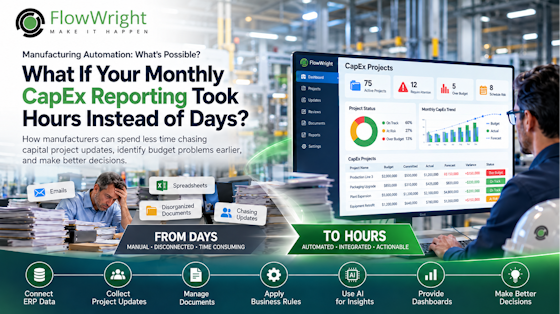
How manufacturers can spend less time chasing capital project updates, identify budget problems earlier, and make better decisions.
Imagine managing 75 capital projects and spending five days every month chasing updates, reconciling ERP numbers, and trying to figure out which projects are running over budget.
Now imagine getting that work done in a few hours—and identifying a potential $200,000 cost overrun weeks earlier, while there's still time to do something about it.
That's the kind of improvement manufacturers could achieve by rethinking how they manage capital project updates.
Yet in many companies, getting a reliable picture of capital spending still involves spreadsheets, emails, disconnected systems, and a lot of manual coordination.
Why is something so important still so difficult?
The monthly CapEx update scramble
Think about what happens when it's time for the monthly or quarterly capital project review.
Finance or capital planning needs updates on dozens, sometimes hundreds, of active projects.
That means reaching out to project managers for spending forecasts, commitments, expected completion dates, and explanations for changes.
Some updates arrive quickly. Others require reminders. Information comes back in different formats, supporting documents are scattered across emails and folders, and someone has to reconcile everything against the ERP system.
And just when the reports seem ready, another project manager reports a change in cost or schedule.
Now someone needs to understand what changed, why it changed, and who needs to review it.
The frustration isn't that people aren't doing their jobs. It's that the process depends on so many people manually coordinating information that should be much easier to collect, review, and act on.
The ERP has the numbers. So why is everyone still chasing information?
Most manufacturers already have valuable capital project information in their ERP systems.
Approved budgets, actual expenditures, purchase orders, and outstanding commitments may all be available.
But those numbers only tell part of the story.
Consider a project with a $2 million budget. The ERP shows $1.2 million in actual spending and another $500,000 in outstanding purchase commitments.
What it may not tell you is that a supplier just increased its price, installation has been pushed back six weeks, or the project manager expects another $450,000 in costs beyond what's already spent or committed.
Suddenly, that $2 million project is forecast to cost $2.15 million.
Unless someone captures that information, explains the change, and gets it in front of the right people, leadership may not know there's a problem until the next reporting cycle.
The financial data exists. The people who understand what's happening exist. But bringing everything together into a timely, reliable picture is often harder than it should be.
The bigger problem isn't reporting. It's what happens when information is late.
It's easy to think of CapEx updates as an administrative burden. And the hours spent chasing project managers, consolidating spreadsheets, and reviewing submissions certainly add up.
But the consequences can extend much further.
Budget surprises. Projects that appeared to be on budget suddenly need additional funding because cost changes weren't communicated early enough.
Delayed decisions. Finance and operations leaders can't respond quickly when they don't have current information.
Lost productivity. Engineers and project managers spend time preparing reports and answering follow-up questions instead of moving projects forward.
Limited capital visibility. The CFO may know how much capital has been approved but struggle to see what's committed, spent, or likely to be needed.
Operational consequences. When investments involve new production capacity or equipment upgrades, delays can affect productivity, customer commitments, and revenue opportunities.
Consider a manufacturer installing a production line to support growing customer demand.
If the project falls behind schedule, the problem isn't simply a late report. The company may need to extend overtime, outsource production, delay deliveries, or postpone expected savings.
The sooner leadership knows what's happening, the more options it has.
Better CapEx management isn't just about producing reports faster. It's about making better decisions while there's still time to act.
Why is this still so difficult?
In many companies, the CapEx update process has evolved over time.
Finance relies on ERP reports and spreadsheets. Engineering maintains project schedules and forecasts. Project managers have supporting documents and vendor communications. Everyone has different responsibilities and priorities.
None of these approaches is necessarily wrong.
The challenge is getting them to work together.
Multiply the effort of collecting financial data, requesting updates, comparing forecasts, reviewing variances, and consolidating reports across 50 or 100 projects, and it's easy to see why the process becomes overwhelming.
And asking everyone to submit their spreadsheets sooner doesn't necessarily solve the problem.
The process itself needs to work better.
What would a better CapEx update process look like?
Imagine starting the monthly reporting cycle without having to manually assemble everything.
Finance selects the projects requiring updates, and project managers receive their assignments.
Instead of relying on disconnected spreadsheets and emails, the process brings financial information, project forecasts, supporting documents, and reviews together.
Project managers can focus on what's changed, what's expected to happen next, and whether there are risks to the budget or schedule.
Business rules can flag variances that need additional explanations or reviews, ensuring potential problems get to the right people.
And there are opportunities to take this further.
ERP integration can bring actual spending, commitments, and approved budgets directly into the process. AI can help review supporting documents and identify relevant changes. Automated reminders can reduce the need to chase overdue updates, while management dashboards can provide a clearer picture of which projects are on track and which need attention.
Instead of spending five days assembling reports, imagine getting a reliable picture in hours.
Instead of discovering an overrun after the fact, imagine identifying it early enough to adjust the project, negotiate with a supplier, or reconsider spending priorities.
That's where the real value comes from—not simply automating tasks, but helping people spend less time gathering information and more time acting on it.
Getting from the current process to something better
Improving CapEx updates doesn't necessarily require replacing an ERP system or taking on a major IT project.
At FlowWright, we help manufacturers identify opportunities like this and turn them into working solutions quickly.
Our software can connect people, ERP and other systems, documents, business rules, AI, and workflows. Just as importantly, our team works alongside yours to understand the process, identify practical improvements, and help get the solution implemented.
Companies can start with a focused process like CapEx updates and expand it as their needs evolve, without requiring a large internal development team.
A question worth asking
How much time does your organization spend each month collecting and reconciling CapEx updates?
And how quickly can leadership identify which projects are running over budget or falling behind schedule?
There's no shortage of opportunities to improve business processes in manufacturing.
Sometimes the best place to start is with something everyone already knows takes too much time.
CapEx updates may be one of those opportunities.
See what a better CapEx update process could look like
This short demonstration shows how FlowWright coordinates capital project updates, supporting documents, reviews, and reporting. It's one example of what's possible. The process can also be extended to connect ERP data, automate follow-ups, and provide additional reporting based on your company's needs.
Visit our Manufacturing Automation page to watch the CapEx Updates demonstration.
The link takes you to FlowWright's manufacturing page, where you'll find the CapEx Updates video.
Coming Next: Why Is Asset Reconciliation Still So Time-Consuming?
CapEx updates are just one example of how disconnected information and manual processes create unnecessary work in manufacturing.
In our next article, we'll explore another challenge: asset reconciliation.
Why does keeping asset records accurate require so much effort? What happens when information doesn't match across systems? And how much time could Finance and Operations save by identifying and resolving discrepancies automatically?
We'll look at the hidden costs, the business impact, and what's possible when financial information, business rules, and people work together.
And just like CapEx updates, we'll show an example of how the process can be automated.