For decades, programming has meant writing code: classes, methods, APIs, database calls, UI handlers, background jobs, and integration logic. That model is still powerful, and it is not going away. But the way organizations build software is changing. Business teams need applications faster. IT teams need better control. Compliance teams need visibility. Operations teams need automation that can evolve without waiting months for a development cycle.
That is where FlowWright changes the programming model.
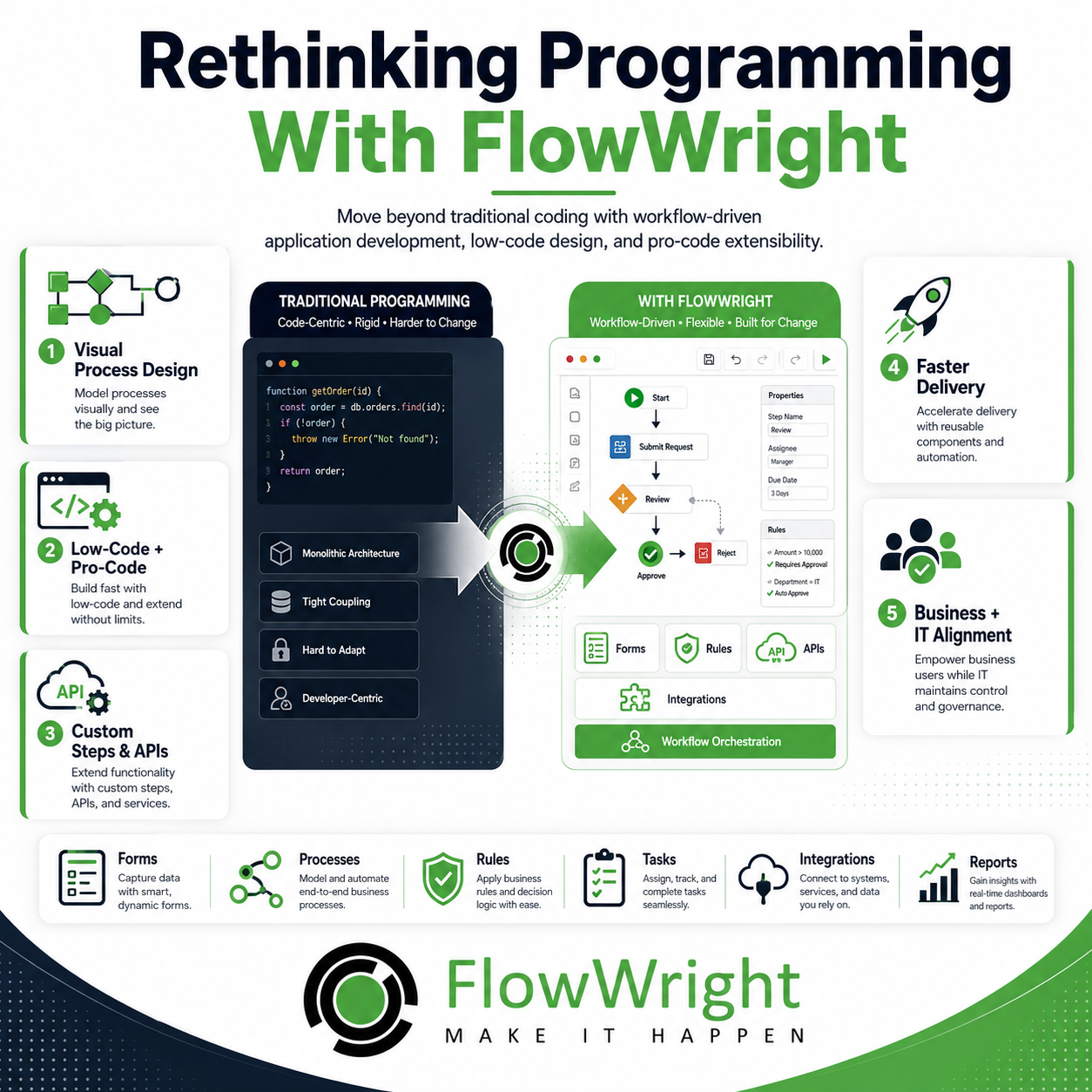
FlowWright does not replace software development. It rethinks how business logic, process logic, human work, system integration, decisions, approvals, and automation are built. Instead of burying everything inside code, FlowWright lets organizations model work as visual, executable processes. These processes become the application logic.
In traditional software, a developer writes logic like this:
if (invoiceAmount > approvalLimit)
{
SendForApproval();
}
else
{
PostToERP();
}
In FlowWright, that same business rule can be represented as a process path, decision step, approval task, integration step, and audit trail. The logic becomes visible, configurable, versioned, secured, and executable.
That is the shift: programming is no longer only about writing code. Programming becomes the act of designing executable business behavior.
The Problem With Traditional Programming
Traditional programming works well when requirements are stable and logic is technical. But business processes are rarely stable. Approval rules change. Compliance requirements change. Departments reorganize. Customers request exceptions. Integrations get added. Audit requirements become stricter. A simple workflow inside code can quickly become a complex web of conditions, flags, status fields, scheduled jobs, and notification rules.
The common result is application rigidity.
A business user asks for a change:
“Can we add legal review when the contract value is over $250,000 and the customer is in a regulated industry?”
In a traditional application, this usually means:
- A business analyst writes requirements.
- A developer modifies code.
- QA tests the change.
- DevOps deploys the update.
- The business waits.
- The process is still hard to see.
Even worse, the process logic may be spread across the application: some logic in the UI, some in the database, some in services, some in scheduled jobs, and some in email templates.
This makes the application harder to maintain, harder to audit, and harder to evolve.
FlowWright solves this by separating process logic from application code.
FlowWright Turns Business Logic Into Executable Process Models
FlowWright allows business processes to be designed visually using steps, links, rules, forms, tasks, integrations, timers, events, and decisions. These process definitions are not static diagrams. They are executable models.
A FlowWright process can:
- Route work to users or roles.
- Call REST APIs.
- Execute business rules.
- Integrate with databases.
- Generate documents.
- Trigger AI services.
- Wait for external events.
- Escalate overdue work.
- Handle approvals and rejections.
- Track every action in an audit trail.
- Manage long-running business transactions.
This means the process diagram becomes the program.
For example, instead of hardcoding an employee onboarding process into an HR application, FlowWright can define the process visually:
- Create employee record.
- Assign HR task.
- Notify IT.
- Provision equipment.
- Create accounts.
- Collect signed documents.
- Schedule orientation.
- Confirm manager approval.
- Complete onboarding.
Each step is configured, secured, tracked, and executed by the FlowWright engine.
The application does not need to know every detail of the onboarding process. The application only needs to start the process, pass in data, and let FlowWright orchestrate the work.
That is a better model for modern enterprise applications.
Programming Becomes Configuration Plus Extension
Rethinking programming does not mean eliminating developers. It means using developers where they create the most value.
In FlowWright, much of the application behavior can be configured visually. But developers can still extend the platform with custom steps, APIs, connectors, rules, UI components, and business services.
This creates a clean division:
Business process logic belongs in FlowWright.
Technical implementation logic belongs in code.
For example, a developer may build a custom C# step called ValidateCustomerCredit. That step can call internal systems, run credit checks, return results, and expose configuration options. Once the step exists, process designers can use it across many workflows without writing code again.
This is powerful because it turns technical code into reusable business building blocks.
Instead of every application implementing its own credit validation logic, FlowWright can expose it as a reusable step inside a process designer. Business users and analysts can then compose that step into larger workflows.
This is not low-code for the sake of low-code. It is architecture.
FlowWright Makes Applications More Adaptable
Enterprise applications often fail because they cannot adapt fast enough. The business changes faster than the software.
FlowWright addresses this by making business behavior external, configurable, and version-controlled.
When a process changes, organizations can modify the FlowWright process definition instead of rewriting application code. A new approval step can be added. A decision rule can be changed. A notification can be updated. A new integration can be inserted. A task can be routed to a different role.
The application remains stable while the process evolves.
This matters especially for industries such as life sciences, banking, manufacturing, government, education, logistics, and energy. These industries operate under constant regulatory, operational, and compliance pressure. They need process automation that can be changed safely without destabilizing the entire application.
FlowWright allows organizations to create process-driven applications where the workflow layer becomes the control layer.
The Process Instance Becomes the Runtime Program
In traditional software, runtime behavior often lives inside application memory, database state, queues, and background jobs. It can be difficult to see where something is, why it is waiting, who owns it, or what happens next.
In FlowWright, every process instance is a runtime program.
A process instance knows:
- What step it is on.
- What data it contains.
- Who needs to act.
- What decisions were made.
- What integrations were called.
- What errors occurred.
- What timers are active.
- What path was taken.
- What remains to be completed.
This gives organizations real operational visibility.
For example, a customer complaint process in a life sciences company may run for days or weeks. It may involve intake, classification, investigation, CAPA, document review, approval, regulatory assessment, and closure. In a traditional application, this could be scattered across multiple tables and modules.
In FlowWright, the entire complaint process is visible as a running process instance.
That visibility is not just useful for users. It is valuable for compliance, auditing, analytics, and continuous improvement.
FlowWright Reduces Hidden Business Logic
One of the biggest problems in enterprise software is hidden business logic. Logic gets buried inside code, stored procedures, event handlers, scripts, configuration files, and email rules.
Hidden logic creates several problems:
- Business users cannot understand how the application works.
- Developers struggle to trace behavior.
- Auditors cannot easily verify process compliance.
- Changes introduce risk.
- Knowledge gets trapped with individual developers.
FlowWright brings this logic into the open.
When a process is modeled visually, the organization can see how work flows. When rules are configured, the organization can inspect them. When tasks are assigned, the organization can track them. When approvals happen, the organization can audit them.
This makes FlowWright especially valuable for applications where process correctness matters.
For example, in a document approval workflow, it is not enough to know that a document was approved. The organization needs to know who reviewed it, which version was reviewed, when approval occurred, whether electronic signatures were captured, whether the correct routing was followed, and whether any exceptions were raised.
FlowWright makes that process behavior explicit.
FlowWright Supports Human, System, and AI Work
Modern applications are no longer just screens and databases. They involve humans, systems, documents, APIs, events, and AI services. Programming these interactions manually can become complex.
FlowWright provides a better abstraction: the process.
A FlowWright process can coordinate:
- Human tasks.
- System integrations.
- API calls.
- Database operations.
- Document generation.
- Document classification.
- AI decisions.
- Event handling.
- Escalations.
- Notifications.
- Rules-based routing.
This is important because enterprise work is not purely automated. Most business processes involve a mix of automation and human judgment.
For example, an invoice exception process may use automation to extract data, match purchase orders, validate amounts, and route exceptions. But a human may still need to approve an unusual vendor charge. AI may help classify the exception, but FlowWright controls the process, assignments, approvals, audit trail, and final outcome.
That is the right model: AI and automation perform work, but FlowWright governs the process.
Rethinking Programming for AI-Driven Applications
AI is changing how software is built, but AI alone does not solve enterprise automation. AI can generate text, classify documents, summarize records, answer questions, and assist users. But AI needs governance.
It needs structure.
It needs process.
A business cannot simply let AI take uncontrolled action inside critical systems. There must be rules, approvals, audit trails, exception handling, security, and traceability.
FlowWright provides that control layer.
Instead of building AI features as isolated tools, organizations can embed AI into FlowWright processes. AI can become a step in a controlled business workflow.
Examples:
- Classify incoming documents.
- Extract data from forms.
- Summarize customer complaints.
- Recommend next steps.
- Generate draft responses.
- Analyze process bottlenecks.
- Answer operational questions.
- Assist with workflow design.
But the process still controls what happens next.
If AI confidence is high, the process may continue automatically. If confidence is low, FlowWright can route the item to a human reviewer. If the action is sensitive, FlowWright can require approval. If something fails, FlowWright can escalate or retry.
This is how enterprise AI should work: not as a black box, but as a governed step inside a business process.
FlowWright as an Application Development Platform
FlowWright is more than a workflow engine. It provides building blocks for creating full process-driven applications.
A FlowWright application can include:
- Forms for data capture.
- Processes for orchestration.
- Tasks for human work.
- Reports for visibility.
- Dashboards for monitoring.
- Rules for decisions.
- APIs for integration.
- Security for access control.
- Audit history for compliance.
- Document management for controlled content.
This means organizations can build applications where the process is the center of the architecture.
For example, a vendor onboarding application can be built with FlowWright using:
- A vendor intake form.
- A vendor risk review process.
- Document upload and verification.
- Legal approval.
- Finance approval.
- ERP integration.
- Dashboard visibility.
- Audit trail and reports.
The result is not just a workflow. It is an application.
This is where FlowWright changes the development model. Instead of building every application from scratch, organizations can assemble applications using reusable process, form, task, report, and integration components.
Developers Still Matter More Than Ever
Some people hear “low-code” or “workflow automation” and assume developers become less important. That is wrong.
FlowWright makes developers more effective.
Developers can focus on:
- Building reusable custom steps.
- Creating secure integrations.
- Designing APIs.
- Implementing complex business services.
- Extending FlowWright capabilities.
- Embedding FlowWright into enterprise applications.
- Building domain-specific automation components.
- Connecting AI services to controlled workflows.
Instead of rewriting the same approval, routing, notification, and audit logic in every application, developers can move that logic into FlowWright and reuse it.
For a Microsoft full-stack development team, this is a practical architecture. C#, SQL Server, REST APIs, .NET services, and enterprise security can remain the technical foundation. FlowWright becomes the process automation layer that coordinates everything.
That is not replacing programming. That is programming at a higher level.
FlowWright Makes Software Easier to Understand
One of the most underrated benefits of FlowWright is clarity.
A process model is easier to understand than thousands of lines of conditional logic. A business user can look at a FlowWright process and understand the sequence of work. A developer can inspect the technical steps. A manager can see bottlenecks. An auditor can review the path taken by each instance.
This creates a shared language between business and IT.
The business no longer has to describe process behavior only in documents. IT no longer has to translate everything into hidden code. FlowWright becomes the living model of how the organization operates.
For example, a change control process can be reviewed by quality, engineering, operations, and IT using the same process model. Each group can understand its role, the approval points, the decision paths, and the controls.
That shared understanding reduces mistakes.
FlowWright Enables Continuous Process Improvement
Traditional applications are often built and then left alone until the next major release. FlowWright enables a more continuous improvement model.
Because processes are visible and measurable, organizations can analyze:
- Which steps take the longest.
- Where work gets stuck.
- Which users or teams are overloaded.
- How many exceptions occur.
- Which paths are most common.
- How many approvals are rejected.
- Where automation can be added.
- Which processes need redesign.
This turns process automation into process intelligence.
For example, if a purchase approval process consistently stalls at finance review, FlowWright can expose that bottleneck. The organization can then redesign routing, add reminders, adjust approval thresholds, or automate validation.
The process becomes measurable. What is measurable can be improved.
FlowWright Changes the Definition of Programming
Programming has traditionally meant instructing a computer what to do through code. But in the enterprise, the bigger challenge is instructing an organization how work should happen.
That includes people, systems, data, documents, decisions, exceptions, deadlines, and compliance rules.
FlowWright expands the definition of programming.
Programming becomes:
- Designing how work flows.
- Defining who does what.
- Configuring decisions.
- Connecting systems.
- Governing AI.
- Managing exceptions.
- Tracking accountability.
- Measuring outcomes.
- Improving operations.
Code still matters. But code becomes one part of a larger automation architecture.
FlowWright gives organizations a way to program the business itself.
A Better Future for Enterprise Software
The future of enterprise software is not only more code. It is more adaptable systems. Systems that can change with the business. Systems that expose process logic. Systems that combine human work, automation, integration, AI, and compliance into one operating model.
FlowWright helps organizations build that future.
With FlowWright, companies can move from hardcoded business logic to configurable process models. They can move from hidden workflows to visible automation. They can move from disconnected applications to orchestrated enterprise processes. They can move from manual follow-up to tracked execution. They can move from uncontrolled AI experiments to governed AI-driven workflows.
That is what it means to rethink programming with FlowWright.
It means building software where the process is not an afterthought.
The process is the application.