
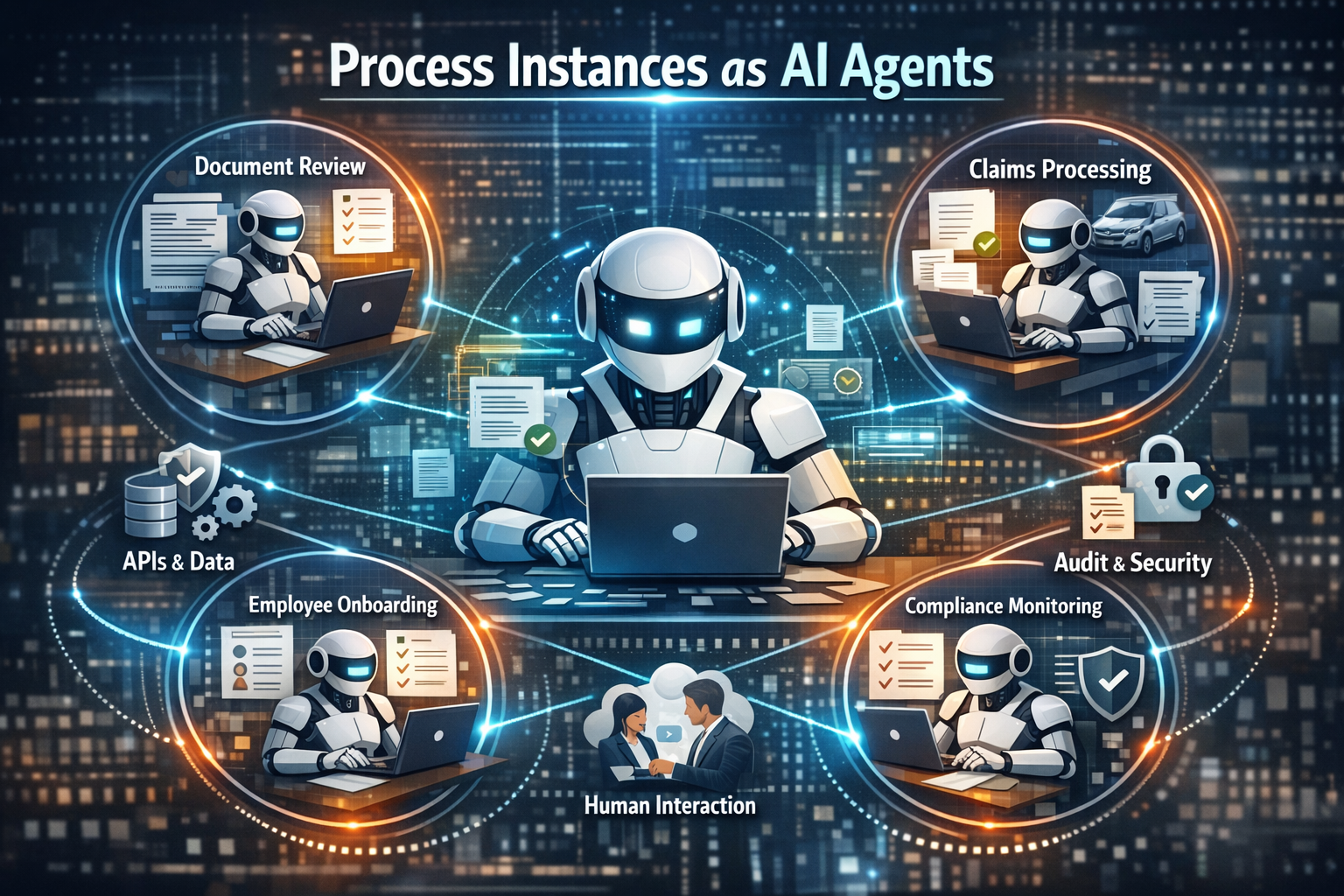
For years, workflow engines have been excellent at orchestrating tasks, routing work, enforcing rules, and capturing audit trails. At the same time, AI has evolved from simple prediction models into systems that can interpret language, reason over data, generate content, and make contextual decisions. The real opportunity is not just to bolt AI onto a workflow platform as a helper feature. The bigger idea is to treat each process instance as an AI agent.
This is a powerful shift in how we think about automation.
A traditional process instance is usually viewed as a passive runtime object. It represents a single execution of a business process. It moves from one step to another, waits for events, stores variables, and completes when the flow is done. Useful, yes, but passive. An AI agent, in contrast, is viewed as active. It has goals, context, memory, access to tools, the ability to interpret changing inputs, and the ability to decide what to do next within bounded controls.
When you combine these two ideas, you get a much more intelligent automation model: the process instance becomes the agent.
What it means
A process instance already has many of the characteristics needed to behave like an AI agent.
It has:
- a unique identity
- a lifecycle
- state and memory
- access to structured and unstructured data
- the ability to call tools, APIs, and services
- rules and decision points
- human interaction points
- security boundaries
- an audit trail
These are not small things. In fact, they are the exact foundations required to build enterprise-grade AI agents that are reliable, governed, and observable.
Instead of thinking of AI as a separate chatbot or sidecar service, think of the running process instance as the active digital worker. The instance has an objective. It knows where it is in the lifecycle. It can examine inputs, interpret documents, call external systems, make bounded decisions, ask for human input when needed, and continue execution until the business objective is achieved.
That is much closer to an agent than to a simple workflow token moving through a diagram.
Why this model matters
Most AI agent discussions focus on loosely controlled autonomous systems. That is exciting in demos, but enterprises need more than intelligence. They need control, security, compliance, reliability, and traceability.
This is where process instances have a huge advantage.
A process instance is not an unbounded autonomous entity. It is a governed execution object operating within a defined process model. That means the AI agent is not free-floating. It is wrapped inside business rules, permissions, approvals, deadlines, exception handling, SLAs, and audit capabilities.
This gives organizations the best of both worlds:
- AI-driven flexibility and reasoning
- workflow-driven governance and control
In other words, process instances make AI agents enterprise-safe.
The process instance already has agent memory
One of the biggest challenges in agent design is memory. Agents need context to operate effectively. They need to know what happened earlier, what data was collected, what decisions were made, what tools were used, and what the current objective is.
A workflow process instance already carries this naturally.
Each instance can maintain:
- process variables
- business data
- user inputs
- system responses
- historical state transitions
- attached documents
- notes, comments, and approvals
- external API results
- AI-generated outputs
This means the process instance does not need an artificial memory model created from scratch. It already has contextual memory built into its execution state. AI can use this memory to reason more effectively and make better decisions.
For example, if an instance is handling a customer onboarding case, it can remember the submitted forms, KYC validation results, policy exceptions, customer communication history, and internal reviewer comments. When AI is invoked, it is not starting from zero. It is acting with the full memory of that instance.
That is exactly how an effective agent should behave.
Goals drive the instance
Agents are goal-oriented. A process instance is also goal-oriented, although in legacy workflow thinking this is not always described that way.
A procurement approval process has a goal: get a purchase request reviewed, validated, and approved or rejected.
A claims process has a goal: assess a claim, gather evidence, make a decision, and notify stakeholders.
An employee onboarding process has a goal: provision the employee, collect required documents, assign training, and complete onboarding.
When AI is embedded into the process instance, the instance is no longer just traversing a flowchart. It is actively pursuing the business goal using all available tools and context.
This is a critical mental model. The agent is not the model. The agent is the running business instance using AI as part of its execution behavior.
Tool use makes the instance intelligent
AI agents become useful when they can use tools. In enterprise systems, these tools are not abstract. They are concrete capabilities such as:
- REST APIs
- database queries
- document services
- email and messaging
- ERP and CRM integrations
- decision tables
- search systems
- OCR and document classification
- identity management
- reporting services
- custom business functions
A process instance already has access to many of these through workflow steps and integration actions. This means it already has the tool layer required for agency.
Now imagine a running instance that can decide:
- to call a document classification service when a file arrives
- to invoke a policy-check API when risk exceeds a threshold
- to query prior history before routing a task
- to generate a customer response draft based on the case context
- to ask a human reviewer for clarification only when confidence is low
- to escalate automatically when deadlines are at risk
At that point, the process instance is clearly operating as an AI agent. It is sensing, interpreting, deciding, and acting.
Human-in-the-loop becomes a native agent pattern
One of the biggest weaknesses in many consumer-style agent discussions is the assumption that full autonomy is always the goal. In enterprise environments, that is often the wrong design.
The better design is controlled autonomy.
Process instances are ideal for this because human participation is already native to workflow. Human tasks, reviews, approvals, escalations, delegation, and exception handling are standard process behaviors. So when an instance as agent reaches uncertainty, it can naturally defer to people.
Examples:
- An invoice-processing instance can auto-match and auto-code standard invoices, but ask finance to review unusual cases.
- A contract-review instance can summarize clauses and flag risk, but send legal exceptions for approval.
- A customer-service instance can prepare a recommended resolution, but allow an agent to approve outbound communication.
- A compliance-monitoring instance can identify suspicious activity, but require a human sign-off before enforcement action.
This is not a weakness. This is enterprise-grade design.
The most effective AI agents in business are rarely fully autonomous. They are collaborative agents operating within a governed process. That is exactly what process instances enable.
Observability and auditability are built in
Another major issue with many AI systems is lack of traceability. Why did the AI make that recommendation? What data did it use? What actions did it take? Who approved the final outcome? Which model was used? Which prompt template was applied? What external systems were called?
A workflow engine can answer these questions far better than most standalone AI agent frameworks.
Because the agent is the process instance, the enterprise can capture:
- every step executed
- every model invocation
- every prompt or instruction template used
- every decision outcome
- every human approval
- every document or data source referenced
- every system integration called
- every exception and retry
- full timing, SLA, and performance metrics
This transforms AI from a black box into an auditable digital worker.
For regulated industries, this is enormous. It allows organizations to deploy AI without sacrificing governance. Instead of asking whether agents can be trusted, the enterprise can ask whether the process design, permissions, and controls around the instance are sufficient. That is a much more manageable question.
Process models provide bounded autonomy
The phrase “bounded autonomy” is important here.
AI agents should not be allowed to do everything. They should be allowed to do the right things within defined boundaries. A workflow process model is a perfect boundary definition mechanism.
The process defines:
- what the instance is trying to achieve
- what actions are permitted
- which systems it can access
- what data it can use
- when human review is required
- what thresholds trigger escalation
- what compliance rules must be enforced
- what constitutes completion or failure
This means the process model acts as the policy envelope for the AI agent.
That architecture is much safer than an open-ended agent with broad system permissions and loosely defined goals. With process-driven agents, autonomy is deliberate, controlled, and measurable.
Real-world examples
Intelligent document approval
A document review process instance receives a contract. It extracts text, classifies the document type, compares clauses against approved standards, summarizes risk, routes exceptions to legal, and drafts reviewer notes. It is not merely following fixed routes. It is interpreting content and choosing actions based on context.
Claims handling
A claims process instance ingests forms, photos, and supporting evidence. It validates policy details, detects missing information, evaluates claim patterns, requests additional documents, recommends a settlement path, and routes only high-risk items to adjusters. The instance behaves like a digital claims agent.
Employee onboarding
An onboarding instance provisions accounts, generates training tasks, validates document submission, answers employee questions through AI-assisted responses, and monitors completion milestones. It adapts to role type, geography, and department. It is effectively an onboarding agent tied to a governed process.
Compliance monitoring
A compliance process instance continuously evaluates regulatory changes, internal policy mappings, impacted departments, and required control updates. It can generate task plans, draft notices, and escalate based on severity. This is not just reporting. This is active agentic compliance orchestration.
The architecture advantage
Treating process instances as AI agents also simplifies architecture.
Instead of creating a disconnected agent platform and then trying to integrate it back into business systems, the workflow engine becomes the orchestration fabric for agents. That reduces fragmentation.
You get:
- one runtime for business execution
- one security model
- one audit model
- one state model
- one integration layer
- one lifecycle management model
AI is then embedded as a capability inside that runtime rather than standing apart from it.
This approach also scales better operationally. Enterprises already know how to monitor process instances, manage retries, secure endpoints, control access, and tune workloads in workflow platforms. Extending that foundation to AI agents is much more practical than introducing an entirely separate operational stack.
The future of BPM and AI
Business Process Management is no longer just about automating repeatable steps. The next phase is about creating intelligent execution entities that can reason, adapt, and collaborate while still operating within enterprise controls.
That is why “Process Instances As AI Agents” is such a meaningful idea.
It redefines the process instance from a passive execution artifact into an active business actor.
It brings AI into the heart of process execution rather than leaving it at the edge.
It allows organizations to build digital workers that are not only smart, but also secure, observable, compliant, and aligned to real business outcomes.
This is where workflow platforms become much more than automation engines. They become the runtime environment for enterprise AI agents.
The future is not workflows on one side and AI agents on the other. The future is their convergence.
When a process instance can hold context, pursue goals, use tools, make bounded decisions, collaborate with humans, and produce auditable outcomes, it is no longer just a workflow instance. It is an enterprise AI agent.
And that may be one of the most practical, scalable, and governable ways to bring AI into real business operations.