
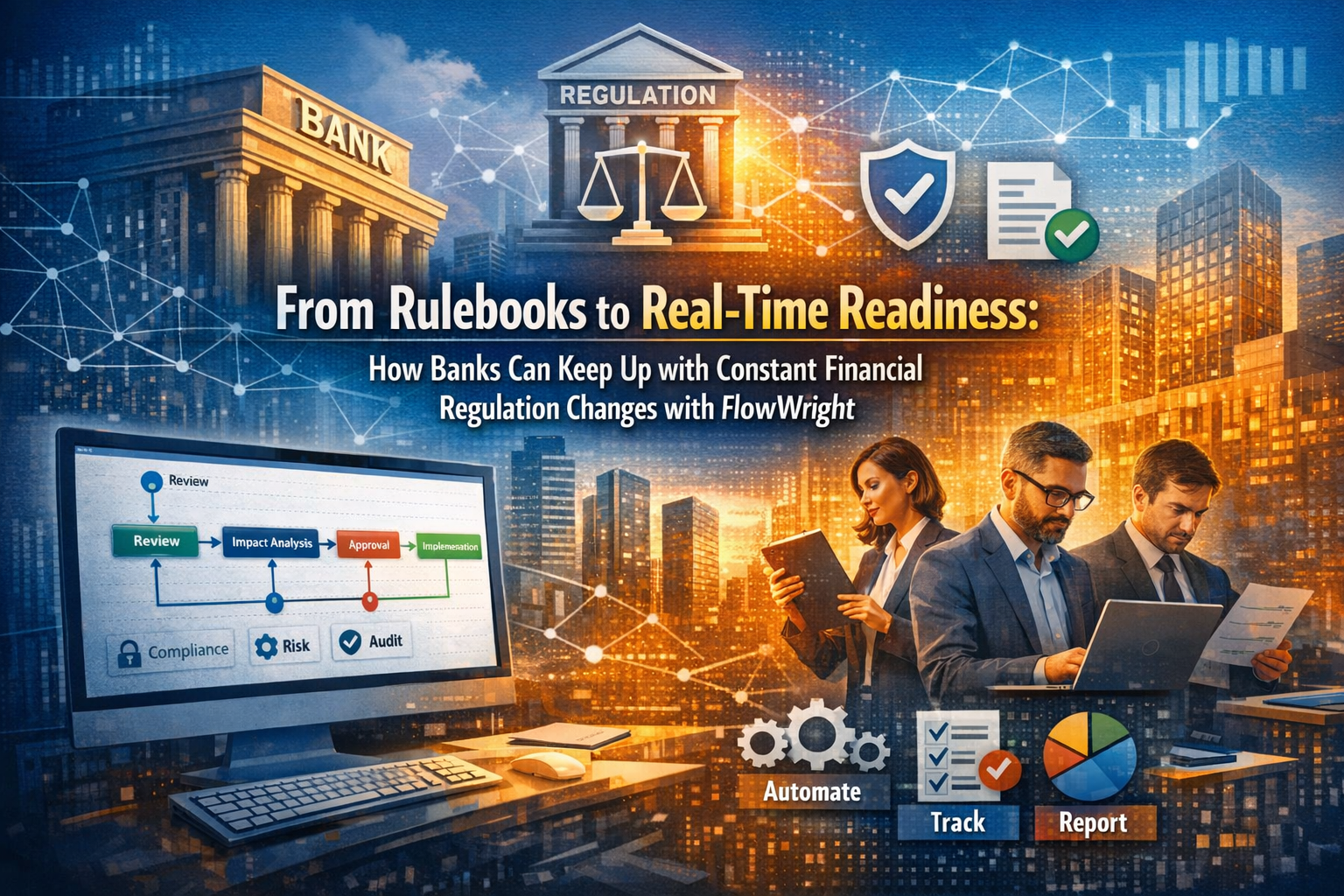
Banking has never been a static industry, but regulation changes today move faster, reach deeper, and carry higher consequences than ever before. New guidance, revised rules, audit expectations, reporting obligations, cybersecurity requirements, consumer protection mandates, and risk governance standards arrive from multiple directions at once. A single bank may need to monitor changes from federal regulators, state regulators, international frameworks, internal policy committees, and third-party risk obligations, all while keeping day-to-day operations running without interruption.
For most banks, the challenge is not simply knowing that a regulation changed. The real challenge is operationalizing the change. Who reviews it? Who determines business impact? Which teams need to respond? What policies, controls, forms, systems, customer communications, and training materials must be updated? How do you prove to auditors and examiners that the bank identified the change, assessed it, acted on it, and verified compliance?
This is where many institutions struggle. Regulatory change management often lives across email threads, shared spreadsheets, ad hoc meetings, disconnected repositories, and manual follow-ups. That approach may work when the volume is low. It fails when regulation becomes continuous, interconnected, and highly scrutinized.
This is exactly where FlowWright brings value.
FlowWright gives banks a structured, automated, and auditable way to manage financial regulation changes from intake to impact analysis to execution and evidence retention. Instead of handling regulatory updates as loose tasks spread across departments, banks can run the entire lifecycle as a controlled business process.
Why regulatory change management is so hard for banks
Banks operate in one of the most regulated environments in the world. A change in a rule or guidance document can affect lending, deposit operations, fraud controls, AML procedures, KYC workflows, disclosures, complaint handling, model governance, cybersecurity, third-party risk, and reporting obligations. Even a narrowly scoped update can ripple across multiple departments.
The difficulty usually comes from five common problems.
First, monitoring sources is fragmented. Regulatory updates come from many bodies, and each source may publish in a different format and cadence.
Second, impact assessment is manual. Compliance teams often need to chase subject matter experts across legal, operations, IT, security, risk, and business units to understand what has changed and what it affects.
Third, execution is inconsistent. Once an issue is identified, there is often no single system coordinating policy revisions, control changes, implementation work, testing, approvals, and deadlines.
Fourth, evidence is scattered. During audits or examinations, proving what happened and when it happened becomes a project of its own.
Fifth, accountability is blurry. Without a workflow-driven system, tasks get delayed, reassigned informally, or lost in email.
Banks do not need more awareness alone. They need repeatable execution.
The better approach: treat regulatory change as an end-to-end workflow
Regulatory change management should be managed like any other critical enterprise process: with intake, routing, decisioning, assignments, approvals, escalations, SLAs, audit logging, dashboards, and reporting.
That is the operating model FlowWright enables.
FlowWright is a workflow and process automation platform that helps banks orchestrate regulatory change management in a disciplined and scalable way. It allows teams to define exactly how regulation changes are captured, reviewed, analyzed, approved, implemented, tracked, and archived. Instead of relying on people to remember the next step, the system drives the process forward.
A bank can configure FlowWright to build a complete regulatory change pipeline that includes:
- change intake from internal or external sources
- automated classification and routing
- legal and compliance review
- business impact analysis
- task assignment to affected departments
- document and policy update workflows
- sign-off and approval steps
- testing and validation checkpoints
- audit trail generation
- dashboards, alerts, and escalations
The result is not just faster compliance activity. It is more reliable compliance execution.
How FlowWright helps banks keep up with financial regulation changes
1. Centralized intake of regulatory updates
Banks often monitor multiple regulatory and policy sources. FlowWright can serve as the centralized intake point for regulation updates. Whether changes are captured manually by compliance staff, submitted through forms, imported through integrations, or triggered by external monitoring systems, FlowWright can normalize them into a standard workflow.
Each update can be stored with key metadata such as regulator name, source, publication date, effective date, regulation category, risk level, business areas affected, and required response timeline.
This creates a single source of truth for regulatory change activity.
2. Automated routing to the right stakeholders
Not every regulatory change should go to the same team. A cybersecurity rule should go to security and IT. A lending disclosure change should go to retail banking, legal, and operations. An AML update should go to compliance, fraud, and branch operations.
FlowWright can route items dynamically based on metadata, business rules, decision tables, or organizational ownership. This ensures the right people are engaged immediately without relying on manual forwarding.
Banks can also configure role-based assignments so that responsibility follows organizational structure rather than individual inboxes.
3. Structured impact analysis across departments
One of the biggest gaps in regulatory change programs is inconsistent impact analysis. Some teams review deeply; others respond casually. FlowWright solves this by standardizing the review process.
Each stakeholder can receive a guided task or form asking specific questions such as:
- Does this change affect existing policy?
- Does it impact customer-facing documents?
- Does it require a system change?
- Does it affect controls, reporting, or audit procedures?
- Is staff training required?
- What is the implementation target date?
Responses can be captured in a structured format, scored, and consolidated for compliance leadership review. This creates consistency, speed, and traceability.
4. Workflow-driven implementation of required changes
Once impact is confirmed, FlowWright can automatically launch downstream implementation processes. These may include policy revision workflows, application change requests, control redesign tasks, test plan execution, training assignments, or document review and approval cycles.
This is where FlowWright becomes especially valuable. It is not just a tracker. It is an orchestration engine.
A single regulatory change can spawn multiple coordinated workstreams, each with owners, due dates, dependencies, approvals, and escalations. Management gets visibility into status across all workstreams in real time.
That means regulatory response stops being a static compliance log and becomes a managed operating process.
5. Strong approval controls and governance
Banks need proof that regulatory interpretations and response plans were reviewed and approved by the right people. FlowWright provides configurable approval chains for legal, compliance, risk, operations, IT, and executive stakeholders.
Approvals can be sequential, parallel, conditional, or based on thresholds such as risk level or affected business lines. Escalation rules can trigger when deadlines are missed or high-risk items remain unresolved.
This creates disciplined governance without adding manual coordination overhead.
6. Full audit trail for exams and internal audit
One of the most important benefits of FlowWright is its auditability. Every task, assignment, approval, comment, document update, and status change is logged as part of the workflow history.
When internal audit, external audit, or regulators ask for evidence, the bank can show:
- when the change was identified
- who reviewed it
- what impact was determined
- what actions were assigned
- when approvals occurred
- what documents were updated
- when implementation was completed
- what supporting evidence exists
This dramatically reduces the time and pain involved in compliance validation and regulatory examinations.
7. Dashboards, alerts, and executive visibility
Regulatory change management should never be invisible until something goes wrong. FlowWright provides dashboards and reporting so compliance leaders and executives can see what is open, overdue, high risk, awaiting approval, or completed.
Banks can build dashboards by regulator, by business unit, by status, by due date, or by risk category. Automatic alerts can notify teams when deadlines approach or critical steps remain incomplete.
This visibility helps leadership move from reactive management to proactive oversight.
8. Integration with documents, forms, and core enterprise systems
Banks do not manage compliance in a vacuum. Regulatory change often touches policy documents, customer communications, ticketing systems, document repositories, identity systems, and internal applications.
FlowWright can integrate with existing enterprise environments so that workflows connect with the systems already in use. A policy document can be routed for review and approval. A form can capture business impact details. A system task can be created for IT. A final compliance package can be stored in the bank’s document repository.
This reduces swivel-chair work and keeps process execution connected to real operational systems.
A practical example
Consider a new regulatory guidance update related to consumer disclosure timing.
In a manual environment, compliance sends an email, schedules meetings, updates a spreadsheet, follows up repeatedly, and hopes all affected teams respond. Evidence is pieced together later.
With FlowWright, the process is different.
The regulatory update is entered into the system or imported automatically. FlowWright classifies it and routes it to compliance, legal, retail operations, lending, customer communications, and IT. Each group receives a structured impact task with due dates. Their responses are consolidated for review. Once approved, FlowWright automatically launches policy updates, disclosure template revisions, testing tasks, and training assignments. Approval steps ensure sign-off. Dashboards show progress. The complete history is stored for audit.
The bank gains speed, control, and defensible evidence.
Why this matters strategically
Banks that manage regulatory change well are not just avoiding penalties. They are building operational resilience. They are reducing compliance fatigue. They are improving coordination between business and technology teams. They are making their control environment more transparent and scalable.
In an industry where regulation is constant, the real differentiator is not who receives updates first. It is who can convert those updates into controlled action with the least friction and the greatest confidence.
FlowWright helps banks do exactly that.
It gives compliance teams a framework for repeatability. It gives business teams clarity on what to do next. It gives IT teams structured intake for change requirements. It gives executives visibility into risk and readiness. It gives auditors and examiners a clean trail of evidence.
Most importantly, it turns regulatory change from a manual burden into a manageable business process.
Financial regulations will continue to evolve. That is a certainty. What banks can control is how they respond.
Trying to manage regulatory change through disconnected tools and manual coordination is increasingly risky, expensive, and hard to defend. Banks need a system that can intake change, analyze impact, coordinate action, enforce accountability, and preserve evidence across the full lifecycle.
FlowWright provides that system.
For banks looking to stay ahead of regulatory change, reduce operational risk, and demonstrate compliance readiness with confidence, FlowWright is not just a workflow platform. It is the operational backbone for modern regulatory change management.