
In large enterprises, there are projects, and then there are moments of truth.
A cutover is one of those moments.
It is the final, high-pressure transition from preparation to production. It is the point where planning, systems, teams, dependencies, approvals, data movement, communications, and accountability all collide. If anything slips, the business feels it immediately. Deadlines move. Stakeholders escalate. Customers notice. Teams work around the clock trying to stabilize what should have been controlled from the start.
For many organizations, cutover management is still handled with a mix of spreadsheets, email threads, status calls, disconnected trackers, and manual coordination. That approach may work for small changes, but it breaks down quickly when the cutover becomes enterprise-scale. Hundreds or thousands of tasks, multiple business units, parallel teams, site-specific dependencies, approvals, contingencies, and timing windows create a level of complexity that manual methods simply cannot absorb.
That is why Bosch’s result is so compelling.
Using FlowWright to design and execute cutovers, Bosch was able to compress cutover plan design what once took 6 weeks, then 2 weeks, down to just 4 hours.
That is not just an incremental gain. That is a complete redefinition of what enterprise cutover execution design can look like. The execution itself might vary based on each of the task performed and their configured durations.
Why cutovers are so difficult
A cutover is never just a checklist.
It is a living operational system that has to coordinate people, tasks, timing, dependencies, and decisions under pressure. In a real-world enterprise environment, a cutover typically includes:
- Pre-cutover validation activities
- Sequenced tasks across multiple teams
- Approval checkpoints
- Contingency branches
- Communications to stakeholders
- Exception handling
- Escalation paths
- Progress monitoring in real time
- Recovery steps when dependencies fail
- Post-cutover validation and closure
The bigger the program, the harder this becomes. A single missed dependency can delay an entire stream of work. A team waiting on another team may lose hours. A status call may report green while the actual blocking task is still open. The plan may exist on paper, but execution becomes reactive and fragmented.
This is where many organizations lose time. Not because their people are not capable, but because the execution model is too manual.
When a business relies on spreadsheets and human coordination to run a complex cutover, the process itself becomes the bottleneck.
The old way: planning-heavy, execution-light
Traditional cutover management often spends enormous effort building static plans. Teams create documents, timelines, workbooks, ownership lists, and dependency maps. These are useful, but only up to a point.
Once execution starts, static artifacts become stale almost immediately.
Someone updates one sheet while another team works from an older version. Approvals happen in email. A change in one task impacts five downstream tasks, but the dependency chain is not automatically enforced. Leaders ask for status, and teams scramble to manually consolidate updates. Meetings multiply because no one fully trusts the reporting.
This creates a familiar pattern:
- Too much manual administration
- Too little live orchestration
- Too many handoffs
- Too much dependency on heroics
In that environment, it is easy to see why a cutover might stretch across weeks. Even when everyone is working hard, the process framework is fighting them.
Bosch’s outcome shows what happens when that framework changes.
FlowWright as the cutover orchestration engine
FlowWright changes the model from static planning to active orchestration.
Instead of treating a cutover as a document, FlowWright treats it as an executable process. That difference matters.
A process-driven cutover can define:
- Every step in the cutover plan
- The owner of each step
- Start and completion criteria
- Sequencing and dependency rules
- Parallel and sequential execution paths
- Approval gates
- Notifications and escalations
- SLA and timing controls
- Real-time monitoring and auditability
That means the cutover is no longer managed through interpretation. It is managed through execution.
Teams do not need to guess what comes next. They see assigned work. Dependencies are enforced. Approvals are captured in the flow. Status is visible live. Escalations can happen automatically. Leadership can see where the cutover stands without waiting for a manual update cycle.
This is the kind of operational discipline that transforms cutover performance.
From 6 weeks to 2 weeks to 4 hours
The Bosch story is powerful because it shows progressive maturity, not just one good event.
The journey from 6 weeks to 2 weeks to 4 hours reflects what happens when an organization moves from manual coordination to process engineering and then to workflow automation at scale.
Phase 1: The 6-week reality
At six weeks, cutover planning and execution are likely dominated by manual effort. Large lead times are needed because teams compensate for uncertainty with buffers. People over-prepare because visibility is low. Meetings are frequent because confidence is low. Tracking is manual because systems are not driving execution.
A long timeline is often a sign that the organization is trying to reduce risk through extra time instead of through better orchestration.
Phase 2: The 2-week improvement
Cutting the cycle to two weeks already signals a major operational breakthrough. At this stage, the organization has likely standardized planning, improved role clarity, increased visibility, and reduced coordination waste.
This is where many organizations stop and call it a success.
But Bosch went much further.
Phase 3: The 4-hour cutover
A four-hour cutover plan means the process has become highly structured, highly automated, and highly visible.
At that level, the organization is no longer spending time figuring out what to do. It is executing a designed system. The process is pre-modelled, dependencies are known, tasks are assigned, exceptions are managed, and progress is observable in real time.
That is what FlowWright enables.
This is not about doing the same work faster with more effort. It is about redesigning the operating model so the work flows with precision.
What the dashboard tells us
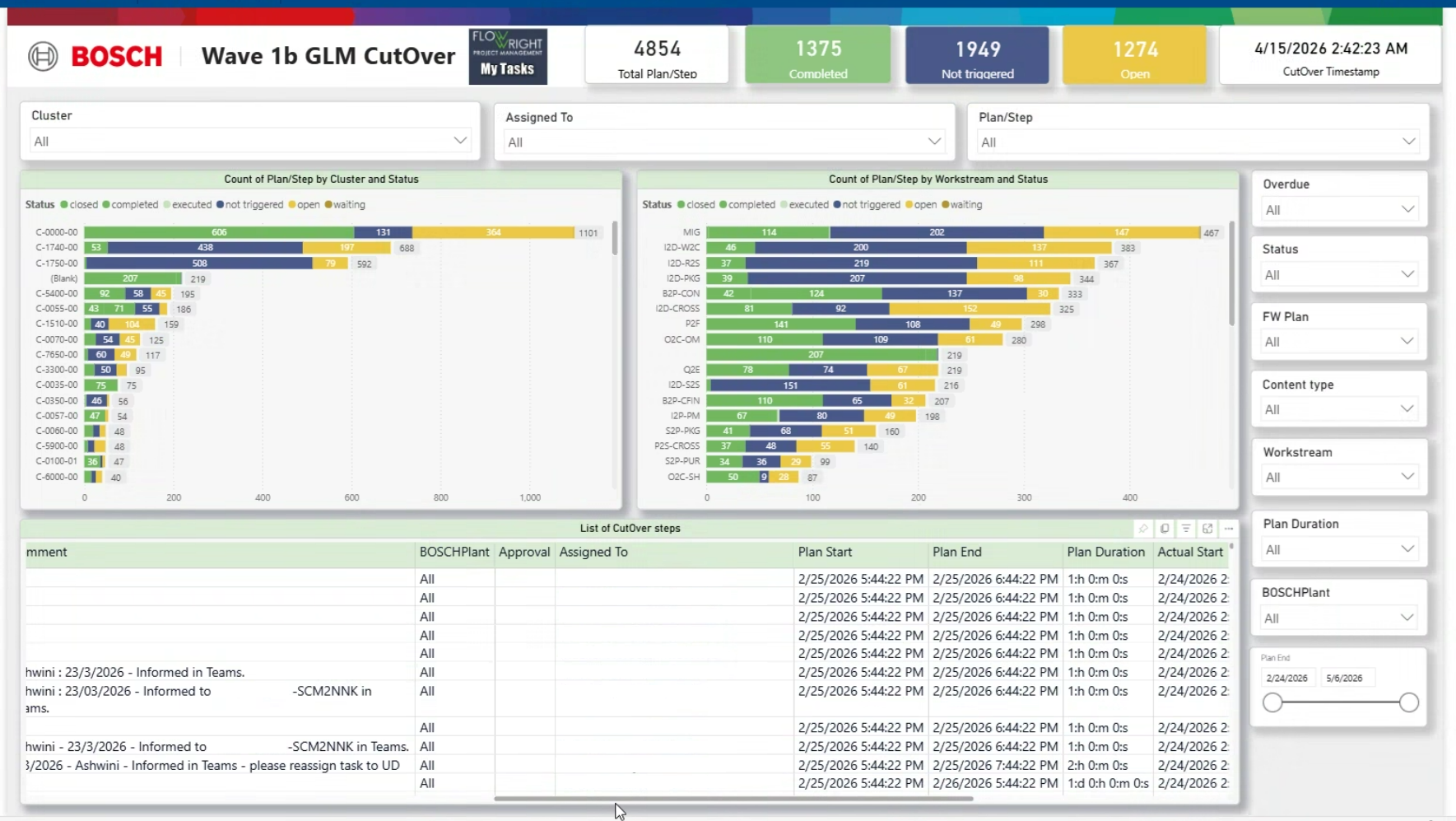
Even from the Bosch cutover report, the value of orchestration is obvious.
The dashboard shows a live operational picture of the cutover:
- Total plan steps
- Completed counts
- Not triggered counts
- Open counts
- Breakdown by cluster and status
- Breakdown by workstream and status
- Assigned-to filtering
- Plan step filtering
- Overdue filtering
- Plant and workstream visibility
- Detailed list of cutover steps with plan start, plan end, duration, and actual start
This is exactly what cutover leaders need during execution.
Not a slide deck. Not a spreadsheet emailed 30 minutes ago. Not a verbal summary with missing context.
They need a command center.
FlowWright turns cutover execution into an operational control plane where managers, business owners, and delivery teams can see what is done, what is open, what is delayed, and what is waiting to be triggered.
That visibility reduces friction at every level.
Why FlowWright is a natural fit for enterprise cutovers
FlowWright is especially effective for cutover management because cutovers are fundamentally workflow problems.
They involve structured steps, rules, participants, deadlines, escalations, decisions, documents, and status. Those are exactly the kinds of problems workflow engines are built to solve.
With FlowWright, organizations can model cutover processes with the same rigor they apply to core business operations. That includes:
1. Process-driven design
Cutover plans can be designed visually as workflows rather than buried in documents. This makes the logic explicit and repeatable.
2. Dependency management
Tasks can be triggered only when prerequisite steps are complete. This prevents teams from starting too early or waiting unnecessarily for manual confirmation.
3. Role-based task assignment
Each activity can be routed to the right person or team automatically, with clear ownership and accountability.
4. Real-time visibility
Leaders can monitor execution across plants, workstreams, clusters, and statuses without waiting for manual rollups.
5. Automatic notifications and escalations
When a task is overdue or blocked, the system can notify the right people immediately.
6. Audit trail and compliance
Every action, approval, and status change can be captured, which is critical in enterprise and regulated environments.
7. Reusability
Once a cutover process is modelled, it can be reused, refined, and scaled across future initiatives.
8. Standardization with flexibility
FlowWright makes it possible to standardize the core cutover framework while still allowing local variations by plant, program, or workstream.
The strategic value goes beyond speed
The headline number is 4 hours, but the deeper value is bigger than speed alone.
Reduced operational risk
A shorter, tightly orchestrated cutover window means less exposure to uncertainty, fewer manual errors, and faster issue detection.
Better predictability
When the cutover runs through an executable workflow, the organization gains consistency. Execution becomes measurable and repeatable.
Less dependency on tribal knowledge
Too many enterprise cutovers rely on a small number of experienced individuals who “know how it all works.” FlowWright captures that logic in the process itself.
Improved stakeholder confidence
Executives, program leaders, and operations teams trust cutovers more when they can see live progress and governance in one place.
Faster transformation cycles
If an enterprise can execute cutovers in hours rather than weeks, it can move faster on ERP upgrades, plant rollouts, system consolidations, and operational transformations.
That is where workflow stops being a technical tool and becomes a business accelerator.
This is what modern cutover management should look like
Bosch’s result is a reminder that enterprise cutovers do not have to remain chaotic, manually coordinated events.
They can be engineered.
They can be modelled.
They can be automated.
They can be monitored in real time.
And they can be continuously improved.
That is the shift FlowWright makes possible.
Instead of asking teams to work harder inside a fragile process, FlowWright gives them a better process. One that handles structure, execution, visibility, and control the way enterprise operations require.
When that happens, the gains are dramatic.
What once took six weeks can become two weeks.
What took two weeks can become four hours.
And what once felt like a high-risk transition can become a managed, repeatable, enterprise-grade operation.
Final thoughts
Bosch’s success with FlowWright is more than a good project story. It is proof that cutover execution can be fundamentally transformed when workflow automation is applied to one of the most complex operational challenges in the enterprise.
For organizations still running cutovers through spreadsheets, email chains, conference bridges, and manual status tracking, the message is clear: the problem is not the scale of the cutover. The problem is the execution model.
FlowWright replaces that model with process-driven orchestration, live operational visibility, accountability, and control.
That is how a six-week cutover becomes a four-hour cutover.
And that is the kind of transformation that changes how enterprises deliver mission-critical change.
If your organization is planning large-scale migrations, ERP deployments, plant transitions, infrastructure changes, or any business-critical go-live event, this is the time to rethink how cutovers are designed and executed.
Because in modern enterprise operations, the winners are not the teams that manage complexity manually.
They are the teams that automate it with FlowWright
















