
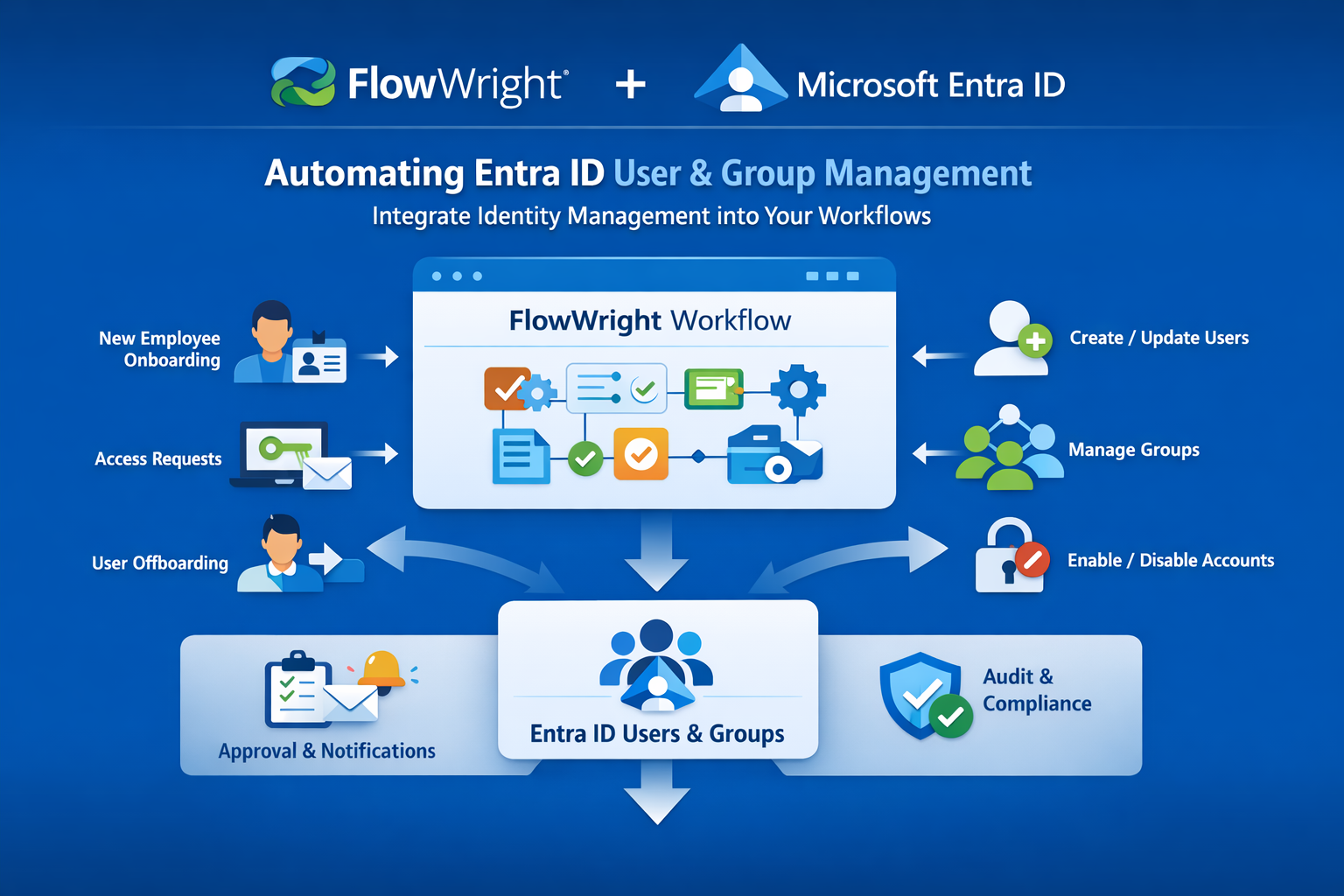
Identity is at the center of every serious business application. It determines who can access systems, what they can do, which applications they can launch, and how security policies are enforced. In many organizations, Microsoft Entra ID has become the primary identity platform for managing employees, contractors, groups, access policies, and application trust. The challenge is that identity work is rarely isolated. It is almost always part of a larger business process.
A new employee joins. A contractor is onboarded. A department changes. A manager requests access to a system. A user leaves the company. A security team needs proof that access was reviewed and approved. These are not just directory operations. They are workflow operations.
That is where FlowWright’s Microsoft Entra ID steps add real value.
FlowWright now enables organizations to work with Entra ID users and groups directly inside automated workflows. Instead of treating identity operations as disconnected administrative tasks, businesses can embed them into governed, auditable, end-to-end processes. This brings IT operations, HR, compliance, and security teams into the same automation framework.
Why identity needs workflow
Most organizations already have identity systems. What they often do not have is process control around identity changes.
A user account may be created, but was the proper approval captured first?
A group membership may be assigned, but was it tied to a role request?
A user may be disabled, but were related downstream tasks triggered?
A team may be restructured, but were all access changes handled consistently?
Without workflow, identity administration becomes fragmented. Help desk teams handle requests in tickets. HR sends emails. Managers approve through chat. Administrators make manual changes in portals or scripts. Audit trails become incomplete, and errors become common.
By building Microsoft Entra ID steps into FlowWright, identity changes can now be orchestrated the same way as any other business-critical process. This means every action can be triggered, validated, approved, logged, and connected to other systems.
What the Entra ID integration enables
FlowWright’s Entra ID steps are designed to let workflow authors interact with Entra ID users and groups as part of automated process execution. These steps can be used in employee lifecycle workflows, access request processes, compliance reviews, governance routines, and operational automations.
At a high level, organizations can use these steps to:
- create and manage Entra ID users
- read and update user profile information
- enable or disable accounts
- query users for downstream decision-making
- create and manage groups
- add or remove group memberships
- validate directory state before moving to the next step
- automate onboarding, transfer, and offboarding flows
- connect identity actions to approvals, forms, notifications, and audit history
The result is simple: identity is no longer a separate admin task. It becomes part of the business process itself.
Better onboarding from day one
One of the strongest use cases for Entra ID workflow steps is employee onboarding.
In many companies, onboarding is still a mix of HR forms, email handoffs, IT tickets, and manual setup. This creates delays, inconsistent access, and security risk. FlowWright changes that by turning onboarding into a controlled workflow that includes identity provisioning.
A new hire process can begin from a form, an HR system integration, an API call, or another enterprise event. Once the workflow starts, FlowWright can gather required information such as name, department, title, manager, office, start date, and access profile. It can then route approvals, generate tasks for stakeholders, and call Entra ID steps to create or update the user record.
From there, the workflow can assign the user to the correct groups, trigger downstream provisioning activities, notify team leads, and produce a complete audit trail. The entire process becomes consistent and repeatable.
This is especially useful for enterprises where access is role-based. Instead of manually determining what each new user needs, FlowWright can apply business rules and assign Entra ID groups automatically based on department, region, job function, or application role.
Streamlining access requests
Access requests are another area where workflow and identity should never be separated.
A manager may need to request application access for a team member. A contractor may need temporary access to a shared resource. A user may require elevated privileges for a short period. In all of these cases, the workflow matters just as much as the final Entra ID update.
With FlowWright, an access request can start from a form or external system, pass through approval steps, validate business rules, and then call Entra ID steps to add or remove group memberships. This creates a governed process rather than an untracked administrative change.
Because FlowWright supports conditional logic, decision rules, escalations, timers, and notifications, access workflows can become much smarter. For example:
- route requests differently based on application sensitivity
- require additional approval for privileged access
- automatically expire temporary access
- notify the requester when the identity change is complete
- log the business reason for the access change
- send the result to audit or compliance systems
This makes identity operations safer and easier to manage at scale.
Improving offboarding and reducing security risk
Offboarding is where workflow-driven identity automation becomes critical.
When users leave an organization, every minute matters. Delays in disabling accounts or removing access can create serious security exposure. Yet many organizations still depend on manual coordination between HR, IT, and business managers.
FlowWright can orchestrate offboarding end to end. Once a termination or separation event is received, the workflow can disable the user in Entra ID, remove group memberships, notify system owners, generate archival tasks, update connected systems, and document every action taken.
This reduces the risk of orphaned accounts, forgotten memberships, and inconsistent deprovisioning. It also gives security teams proof that the process was followed.
Instead of relying on a checklist in an email thread, the organization gets a live workflow with traceability, accountability, and automation.
Group management with business context
Groups in Entra ID are often central to security and application authorization. But group changes are usually made without enough business context. Someone adds a user because of a request, but months later nobody remembers why.
FlowWright helps solve that problem by wrapping group operations inside workflows that preserve intent. When a user is added to or removed from a group, the action can be tied to a request, an approval, a policy, or a business event.
This gives organizations stronger governance over group sprawl and access drift. It also makes group administration less dependent on manual intervention by directory administrators.
For example, FlowWright can support processes such as:
- department-driven group assignment during onboarding
- project-based access groups for temporary initiatives
- manager-approved additions to sensitive security groups
- automated cleanup when employees transfer roles
- scheduled or event-based group membership reviews
The workflow becomes the system of record for why the change happened, not just the fact that it happened.
Built for enterprise control
FlowWright’s strength is not just that it can call identity operations. Its strength is that those operations happen inside a broader enterprise workflow platform.
That means Entra ID steps can work together with:
- FlowWright forms for request capture
- task assignments for approvals and review
- business rules and decision tables
- notifications and escalations
- API integrations with HR, ERP, or ticketing platforms
- document generation and audit evidence capture
- reporting and dashboard visibility
- security permissions and operational traceability
This matters because identity operations usually do not stand alone. Real business processes include multiple participants, multiple systems, deadlines, validations, and compliance expectations. FlowWright is designed to orchestrate all of that.
Better auditability and compliance
Identity governance is not only about getting the right access in place. It is also about proving that it was done properly.
With FlowWright, Entra ID user and group changes can be embedded in workflows that capture approvals, timestamps, request data, reviewer comments, and supporting business context. This creates a much stronger audit record than a script or manual directory change alone.
For regulated industries or enterprises with strict internal controls, this is a major benefit. Audit teams can review not only what changed, but also:
- who requested the change
- who approved it
- what business rule justified it
- when the action occurred
- what downstream tasks were triggered
- whether the process completed successfully
This level of visibility helps organizations improve control maturity while reducing administrative overhead.
Reducing manual work for IT teams
Directory administrators and help desk teams often spend too much time doing repetitive access work. Add a user. Update a profile. Assign a group. Remove a membership. Disable an account. Repeat.
FlowWright’s Entra ID steps allow that repetitive work to be standardized and automated. IT teams can shift from manual execution to managed process design. Instead of being the bottleneck for every request, they become owners of the automation model.
That reduces response time, improves consistency, and frees skilled technical staff for higher-value work.
It also reduces dependency on custom point scripts that only one person understands. When the logic is built into a FlowWright workflow, it becomes visible, maintainable, and governed.
Supporting hybrid and evolving enterprises
Many organizations are still in transition. They may have on-prem systems, cloud apps, legacy approval practices, and evolving governance models. Entra ID sits at the center of a modern identity strategy, but the surrounding business processes are often spread across multiple tools.
FlowWright helps bridge that gap.
A workflow can start from almost anywhere and still use Entra ID steps as part of the orchestration. That allows enterprises to modernize incrementally rather than rewriting everything at once. Existing systems can trigger workflows, and FlowWright can coordinate the identity actions alongside the rest of the process.
This is particularly useful for organizations building repeatable automation patterns across HR, IT, security, and compliance domains.
Real business value
Adding Microsoft Entra ID steps into FlowWright is not just a technical feature. It delivers real operational value:
- faster onboarding and access provisioning
- stronger control over user and group changes
- lower risk during offboarding
- better audit trails and compliance readiness
- reduced manual effort for IT
- more consistent access governance
- easier integration of identity with broader business workflows
In short, it turns identity management from a disconnected admin function into a governed, automated business capability.
Thoughts
Microsoft Entra ID is where enterprise identity lives. FlowWright is where enterprise processes run. Bringing the two together is a natural and powerful step forward.
With Entra ID user and group operations available as workflow steps, organizations can automate identity changes with the same discipline they apply to any mission-critical process. Requests can be captured, approvals enforced, policies applied, tasks orchestrated, and actions audited from beginning to end.
That means fewer manual errors, faster response times, stronger governance, and better security.
For companies already using Microsoft Entra ID, this opens the door to a smarter model of identity automation. Instead of managing users and groups as isolated IT tasks, they can now be part of a complete FlowWright process that aligns business operations with security control.
FlowWright continues to extend workflow beyond forms and approvals into the systems that matter most. Identity is one of the most important of them. And with Microsoft Entra ID steps built into the platform, businesses can automate user and group lifecycle management with clarity, control, and confidence.