Enterprise workflow automation is not a departmental convenience purchase. It is an architectural commitment that determines how an organization models decisions, coordinates systems, governs change, and responds when a critical process fails. The right evaluation therefore begins with operating-model requirements and technical evidence, not a feature-counting exercise. This guide gives enterprise architects and transformation leaders a disciplined way to test whether a platform can remain governable, extensible, and resilient as automation expands across the enterprise.
Get Demo: evaluate your highest-risk workflow with FlowWright and your own architecture team.
What should an enterprise workflow automation platform deliver?
An enterprise platform should coordinate long-running, cross-functional processes while preserving control over identity, data, integrations, versions, and operations. It must give business teams usable visual tools without restricting developers, and it must support deployment, monitoring, recovery, and change management as first-class architectural concerns rather than implementation afterthoughts.
The distinction between task automation and enterprise orchestration matters. A task tool may route a form or trigger a notification. An enterprise platform must manage state across systems, users, time zones, exceptions, and changing business rules. It should make the process understandable to stakeholders while giving technical teams enough control to diagnose and safely evolve production behavior.
FlowWright approaches that problem as an intelligent business process management suite built around an embeddable .NET Core workflow engine. Its platform combines a graphical HTML5 process designer, responsive forms designer, dashboards, reporting, a rules engine, and developer extensibility. The engine can run on one server or distribute load across multiple servers, with automated failover monitoring and processing. That combination is relevant when an enterprise wants a common orchestration layer without forcing every use case into the same implementation pattern.
Several FlowWright capabilities deserve early scrutiny because they affect lifecycle risk, not merely design convenience. The platform supports visual process debugging, custom steps, custom data types, business objects, and more than 300 out-of-the-box workflow steps. It also supports pushing design changes to running instances and dynamic sub-workflows. These capabilities can help teams handle long-lived processes whose logic must adapt after execution has begun.
Verified implementations also demonstrate the range of operating contexts. Kansas Department of Transportation selected FlowWright after an extensive RFP evaluation to replace a 20-year system. St. Louis County uses automation while serving 1.1 million residents. Post Consumer Brands used FlowWright in support of an enterprise-wide ERP system upgrade. These examples do not replace technical validation, but they establish that the platform has been applied in government, manufacturing, and complex transformation programs.
Begin with architecture, not a feature matrix
The strongest evaluation starts by mapping the target operating model to platform architecture. Define execution boundaries, availability expectations, data residency, identity sources, integration patterns, and the ownership of process logic. Only then should a team compare platform capabilities, because an impressive feature can still create unacceptable coupling, operational burden, or governance risk.
Document where the orchestration layer will sit. For some organizations, it will coordinate applications while keeping source-of-record data in existing systems. For others, it will also host forms, rules, dashboards, and process data. The evaluation should show which responsibilities belong in the workflow platform, which remain in enterprise applications, and which are delegated to integration infrastructure.
FlowWright's .NET foundation is particularly relevant to organizations standardized on Microsoft technologies. It offers a .NET SDK, REST APIs, and administrative, runtime, design, and reporting API models. Its built-in Enterprise Service Bus supports event-driven processing, while its microservices framework uses REST API-based services. This allows architects to evaluate visual configuration and code-level extension within one platform boundary.

Deployment topology should be tested as an architectural decision. FlowWright supports on-premises, cloud, container, and hybrid models. The supplied technical materials identify support for Azure, AWS, Google Cloud, Docker, Kubernetes, and OpenShift, as well as split deployments between on-premises and cloud environments. A serious proof of concept should use the topology closest to the intended production model rather than a simplified vendor-hosted demonstration.
Evaluate orchestration depth and change behavior
Orchestration depth is the platform's ability to preserve process state, execute complex rules, coordinate human and system work, and manage exceptions over time. Buyers should test branching, parallel work, sub-processes, event handling, retries, escalation, and changes to active instances. A platform is enterprise-ready only when those behaviors remain visible and controllable in production.
Ask vendors to implement a representative workflow with realistic complexity. Include an approval path, a system integration, a delayed response, a rule change, and an exception that requires human intervention. Then change the design after instances are running. The point is not to produce a polished demonstration; it is to expose how the platform handles state, versioning, recovery, and operator decisions.
FlowWright's visual process debugger provides breakpoints, variable inspection, and execution views. Its dynamic sub-workflows can alter execution based on runtime conditions, and its push-design-change capability can update running instances without a restart. These are material differentiators for processes that remain active for weeks or months, because a rigid instance can otherwise preserve obsolete logic until completion or require disruptive migration.
Rule execution deserves a separate test. FlowWright includes a rules engine that performs real-time in-memory compilation for business logic. Evaluators should determine who may edit rules, how changes are approved, how versions are traced, and whether a rule can be reused across processes. The goal is controlled adaptability: business logic can change without becoming invisible or ungoverned.
Test integration as an operating capability
Integration quality is not measured by connector count alone. It is measured by how reliably the platform exchanges data, responds to events, handles errors, secures credentials, and exposes diagnostics across the integration lifecycle. Evaluate APIs, messaging, custom extensions, data transformation, retries, and observability using the systems and failure modes that matter in production.
A connector can accelerate initial delivery, but enterprise architects should inspect what happens after the happy path. Force a timeout, return malformed data, revoke a credential, and replay an event. Confirm whether the team can distinguish transient failure from invalid business data, prevent duplicate actions, and restore processing without manipulating underlying records.
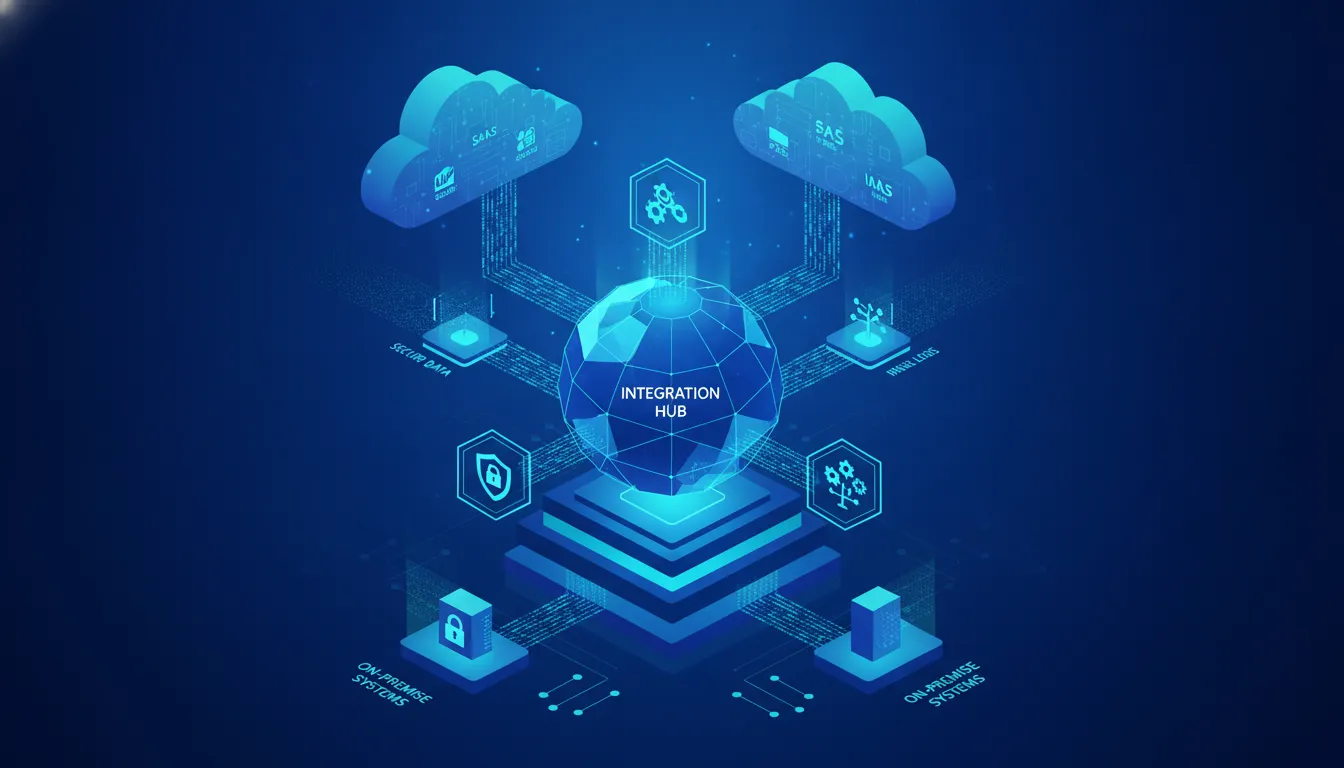
FlowWright provides REST and SOAP API integration through its iPaaS capabilities, along with an Enterprise Service Bus for publish-and-subscribe messaging. The ESB is compatible with RabbitMQ and MSMQ. The platform also supports custom steps, event handlers, business objects, and custom data types, giving developers options when a pre-built integration is not sufficient.
Data-intensive use cases require more than transactional API calls. FlowWright's graphical ETL capabilities support data extraction, cleansing, deduplication, aggregation, format conversion, validation, scheduling, monitoring, and recovery. Its intelligent document processing capabilities add AI, machine learning, OCR, and natural language processing for classification and extraction from unstructured or semi-structured documents. Evaluators should test these capabilities only where they fit a defined process requirement.
Get Demo: bring a real integration, exception path, and deployment requirement.
Require governance without creating a delivery bottleneck
Effective governance makes automation safer and faster by defining ownership, permissions, promotion controls, evidence, and reusable standards. It should prevent unreviewed production changes without forcing every process adjustment through a central development queue. Evaluate how the platform separates environments, enforces roles, records changes, and supports collaboration between business analysts and professional developers.
Start with an explicit responsibility model. Process owners should be accountable for outcomes and policy. Platform owners should govern architecture, reusable components, security, and runtime health. Developers should own coded extensions and integration quality. Operators should have documented authority for recovery and incident response. The platform should support these boundaries rather than relying on informal practice.

FlowWright supports role-based access control, audit logging, version management, and controlled deployment. It also supports environment synchronization across development, QA, and production. Its graphical process, forms, dashboard, and report designers can make solutions understandable to business and technical stakeholders, while the SDK and custom extension model preserve a path for professional development.
Backwards compatibility is another governance consideration because upgrades can create a hidden portfolio of remediation work. The supplied research verifies FlowWright's commitment to compatibility for every version since version 1.0. During evaluation, buyers should still test an upgrade path, inspect deprecated components, and determine how the vendor communicates and supports platform evolution.
Make security and compliance demonstrable
Security evaluation should connect platform controls to the enterprise threat model and compliance obligations. Verify authentication, authorization, encryption, auditability, tenant boundaries, administrative access, and evidence retention. Do not accept a certification statement as a substitute for architecture review; require the vendor to demonstrate how controls operate in the proposed deployment and integration model.
The supplied technical record identifies FlowWright as SOC 2 Type II compliant, HIPAA compliant, and aligned with ISO 27001 practices. It also identifies role-based access control, audit logging, encryption for data at rest and in transit, OAuth 2.0, SAML, Active Directory or LDAP integration, and multi-factor authentication. Each applicable control should be validated against organizational requirements during due diligence.
For an embedded or multi-tenant use case, isolate tenant-boundary testing from general application security. FlowWright supports multi-tenancy for SaaS deployments and offers an OEM SaaS model. Software companies should verify tenant provisioning, data isolation, branding, identity delegation, operational visibility, and upgrade responsibilities before selecting an embedding strategy.
Auditability should extend from design through runtime. Ask whether reviewers can determine who changed a process, who approved it, which version ran, what data influenced a decision, and how an exception was resolved. A useful audit trail must support investigations and compliance evidence without requiring specialists to reconstruct events from unrelated logs.
Prove scalability, resilience, and operational visibility
Scalability is the ability to meet defined workload and recovery objectives while preserving predictable operations. Test concurrent instances, queue depth, integration latency, failover, recovery, and administrative workload under realistic conditions. The evaluation should produce evidence for capacity planning and incident response, not a generic assertion that the platform can scale.
FlowWright's distributed architecture can run on one server or multiple servers to distribute load, and it includes automated failover monitoring and processing. The supplied research records production throughput of more than 300,000 files per week. That is useful evidence of scale, but a buyer should establish its own workload profile and test the bottlenecks most likely to affect its environment.
Operational visibility determines whether scale remains manageable. FlowWright provides real-time workflow tracking, throughput and latency metrics, resource utilization views, queue analytics, graphical process history, and audit capabilities. Its analytics tools should be tested by the people who will operate the platform, with scenarios covering stalled work, downstream outages, growing queues, and a failed deployment.
Define service objectives before the proof of concept. Include peak throughput, acceptable latency, recovery time, recovery point, and availability targets. Then assign ownership for alerts and remediation. A platform can provide rich telemetry while still failing operationally if no team has the authority, context, or runbook needed to act on it.
Assess developer experience and long-term extensibility
Developer experience determines how safely the platform can address requirements beyond visual configuration. Evaluate API quality, SDK ergonomics, testing support, debugging, documentation, extension packaging, and deployment controls. The best low-code platform does not eliminate code; it creates a governed boundary where code is used deliberately and remains maintainable over the system lifecycle.
FlowWright provides a .NET SDK distributed through NuGet, strongly typed interfaces, REST APIs, Visual Studio integration, step-through debugging, and testing support. Its extensibility model includes custom workflow steps, data types, business objects, event handlers, widgets, and form controls. Enterprise teams can review the technical documentation before committing to a proof of concept.
Have developers build one extension that represents a genuine edge case. Require automated tests, configuration management, error handling, secure secret use, deployment into a non-production environment, and rollback. Then have a second developer maintain it. This exercise reveals whether an extension model is merely possible or genuinely sustainable.
Training and support also affect extensibility. FlowWright offers structured training for business analysts and developers, including hands-on work with workflows, forms, engine configuration, ESB integration, custom items, and the .NET API. Its standard program is typically four days for business analysts and developers, or three days for business analysts only. Buyers should account for the operating skills required after implementation.
Examine the embedded workflow decision
Software companies evaluating embedded workflow need a different decision model from enterprises buying an internal platform. The workflow engine becomes part of the product architecture and customer promise. Assess white-label experience, multi-tenancy, API depth, deployment control, upgrade compatibility, debugging, support boundaries, and the effort required to build equivalent capabilities internally.
FlowWright offers an embeddable .NET workflow engine and an OEM model for software companies. The verified capabilities include multi-tenant SaaS support, visual designers, a debugger, APIs, custom extensions, and deployment flexibility. This can allow a software provider to add workflow capabilities without designing and maintaining an orchestration engine from the ground up.
The proof of concept should embed the engine into a representative product workflow rather than demonstrate a standalone process. Test tenant provisioning, product identity, user experience, upgrade behavior, telemetry, and support escalation. Clarify which components appear to end users, which remain administrative, and who owns incidents that cross the boundary between the product and workflow engine.
Use a structured enterprise evaluation checklist
A defensible selection process converts strategic requirements into testable acceptance criteria, assigns accountable reviewers, and preserves evidence. Use the following ordered checklist to move from operating-model definition through technical validation and commercial approval. Weight criteria before demonstrations begin so presentation quality cannot displace architecture, security, operational, and lifecycle priorities.
| Evaluation area | Evidence to require | Primary reviewer |
|---|---|---|
| Architecture | Production-like topology and boundary diagram | Enterprise architect |
| Governance | Role, version, promotion, and audit demonstration | Platform owner |
| Integration | Failure, retry, recovery, and diagnostic test | Integration lead |
| Security | Identity, access, encryption, and evidence review | Security reviewer |
| Operations | Load, failover, queue, alert, and recovery results | Operations lead |
| Extensibility | Tested, deployed, documented custom component | Development lead |
- Define target outcomes and boundaries. Identify the processes, users, systems, regions, and risk categories in scope. State what the orchestration layer will and will not own.
- Map architecture constraints. Document deployment topology, identity providers, data residency, integration standards, availability targets, and required development technologies.
- Model a representative process. Choose a use case with human decisions, system actions, long-running state, a rule, an exception, and an audit requirement.
- Set measurable acceptance criteria. Define expected behavior, throughput, recovery, security controls, operational evidence, and user outcomes before vendors demonstrate solutions.
- Test design and runtime change. Build the process, launch instances, alter logic, migrate or update active work, and verify the resulting audit history.
- Exercise integrations under failure. Test timeouts, invalid responses, revoked credentials, duplicate events, retries, and restoration after a downstream outage.
- Validate security and governance. Review roles, authentication, tenant isolation where applicable, change approval, environment promotion, encryption, and audit evidence.
- Run load and resilience scenarios. Measure peak workload, queue growth, latency, failover, recovery, and the operator effort required to diagnose and resolve issues.
- Build and maintain an extension. Require the development team to create, test, deploy, document, transfer, and roll back a representative custom component.
- Assess adoption and ownership. Confirm training, support, process-owner responsibilities, platform administration, incident response, and the roadmap for reusable components.
- Review lifecycle evidence. Examine upgrade history, compatibility, documentation, vendor support, customer examples, and the likely cost of operating change over several years.
- Score evidence, not promises. Record outcomes against the predetermined weights, document unresolved risks, and require owners and mitigation plans before approval.
This sequence makes trade-offs visible. A platform may be excellent for rapid process design but insufficient for an embedded multi-tenant product. Another may satisfy security requirements but impose excessive extension or operational overhead. The decision record should show why the selected platform fits the intended operating model, not simply why it won a demonstration.
Interpret customer evidence with architectural discipline
Customer examples are most useful when they illuminate fit, implementation complexity, and sustained operation. Treat them as evidence to investigate, not universal proof. Ask what process was automated, which systems were involved, how governance worked, what changed after launch, and whether the customer's constraints resemble your own architecture and risk profile.
FlowWright's documented government examples include Kansas Department of Transportation, St. Louis County, and Finland's Natural Resources Institute. Its industry examples include Post Consumer Brands, a confidential healthcare subsidiary, and Siam Pharmaceutical. The range suggests applicability across public-sector service delivery, enterprise transformation, healthcare operations, and pharmaceutical workflows.
For buyers, the next step is to connect those references to evaluation questions. A government organization can ask about long lifecycle, accessibility, procurement, and audit requirements. A manufacturer can investigate ERP coordination and operational continuity. A healthcare organization can focus on protected data and process evidence. A software company can examine the vendor's embedded deployment experience.
FlowWright has operated since 2004, and its founder, CEO, and CTO Dileepa Wijayanayake has more than 30 years of experience in enterprise software design and delivery. Longevity is not a substitute for technical fit, but it provides useful context when evaluating roadmap stewardship, support, and the accumulated operational knowledge behind the platform.
Plan the proof of concept as a risk-reduction exercise
A useful proof of concept does not attempt to showcase every capability. It targets the uncertainties most likely to invalidate the selection: architectural fit, integration reliability, lifecycle change, security controls, operator visibility, and team capability. Define a short list of risks, build scenarios around them, and require observable evidence for every acceptance criterion.
Use production-like identities, representative data shapes, and a realistic deployment model wherever governance allows. Include at least one failure path and one design change after instances begin. Have prospective process owners, developers, security reviewers, and operators participate directly. Their questions will expose different categories of risk that a procurement-only review can miss.
FlowWright's combination of visual designers, distributed execution, APIs, custom extensions, event-driven integration, analytics, and deployment flexibility gives teams several dimensions to test in one proof of concept. Start with the highest-value process, but deliberately include the hardest technical boundary. A successful simple workflow reveals little about the platform's ability to support an enterprise automation portfolio.
Conclude with an evidence review. Record what passed, what failed, what required vendor assistance, and what remains uncertain. Separate platform limitations from skills gaps or environmental constraints. If a mitigation depends on services, custom development, or a future roadmap item, make that dependency explicit before the final decision.
Frequently asked questions
These answers summarize the core decisions enterprise architects and transformation leaders should resolve before selecting a workflow platform. They focus on architecture, governance, integration, deployment, and proof-of-concept design. Each answer should be validated against the organization's specific operating model, risk obligations, existing systems, and intended automation portfolio.
What is enterprise workflow automation?
Enterprise workflow automation is the governed orchestration of human work, business rules, data, and system actions across an organization. Unlike isolated task automation, it manages long-running process state, exceptions, integrations, security, audit evidence, and lifecycle change across teams and applications.
What should an enterprise workflow automation proof of concept test?
It should test a representative cross-system process, including identity, integrations, rules, human decisions, exceptions, active-instance changes, security controls, operational monitoring, and recovery. It should use measurable acceptance criteria and involve architects, developers, security reviewers, operators, and process owners.
Why does an embeddable workflow engine matter?
An embeddable engine lets a software company incorporate orchestration into its product while retaining control over user experience, integration, and deployment. It can reduce the burden of building and maintaining core workflow capabilities, but buyers must validate multi-tenancy, white-label behavior, APIs, upgrades, telemetry, and support boundaries.
How should teams evaluate workflow platform scalability?
Teams should define workload, latency, availability, recovery time, and recovery point objectives, then test them in a production-like topology. The test should measure concurrent instances, queue depth, downstream delays, failover, recovery, diagnostics, and the operator effort required to restore normal processing.
How does FlowWright support enterprise workflow automation?
FlowWright combines an embeddable .NET Core workflow engine with visual process and forms designers, dashboards, reporting, rules, APIs, custom extensions, distributed execution, automated failover, and multiple deployment models. It also supports event-driven integration, multi-tenancy, visual debugging, and changes to running workflow instances.