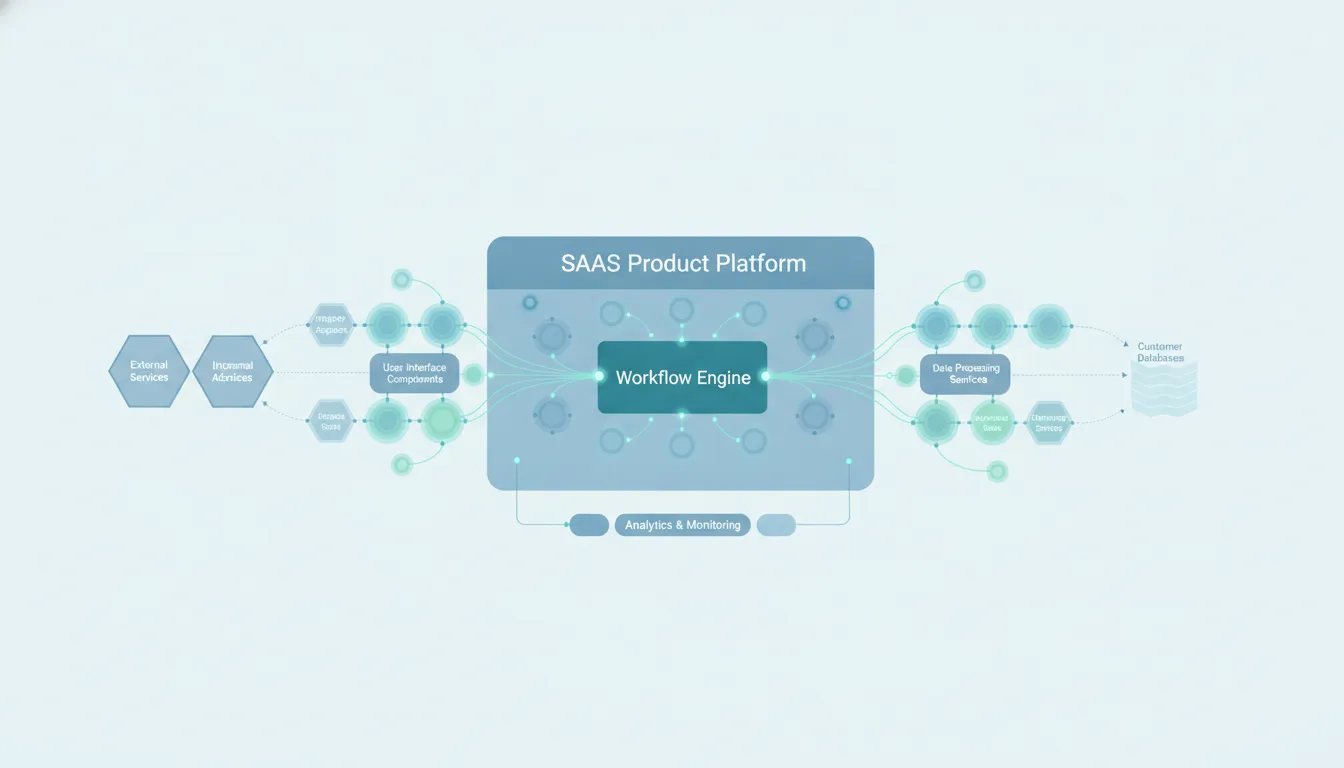
For a CTO, choosing an embedded workflow engine is not a feature-level decision. It is a long-term product architecture and ownership decision. A custom engine may begin as a compact orchestration layer, but enterprise requirements quickly extend the scope into versioning, tenant isolation, auditability, visual design, exception handling, integrations, governance, and safe upgrades. Buying an embeddable engine moves much of that undifferentiated platform responsibility to a specialist while preserving the product team's control over user experience, business logic, and deployment architecture.
Get a FlowWright demo and evaluate the OEM architecture against your product requirements.
The build-versus-buy decision determines which capabilities the product team owns, which operational risks it accepts, and how quickly it can deliver governed automation at enterprise scale. Evaluate the engine as a platform dependency, not as an isolated feature.
What an embedded workflow engine adds to your product
In-process orchestration and control
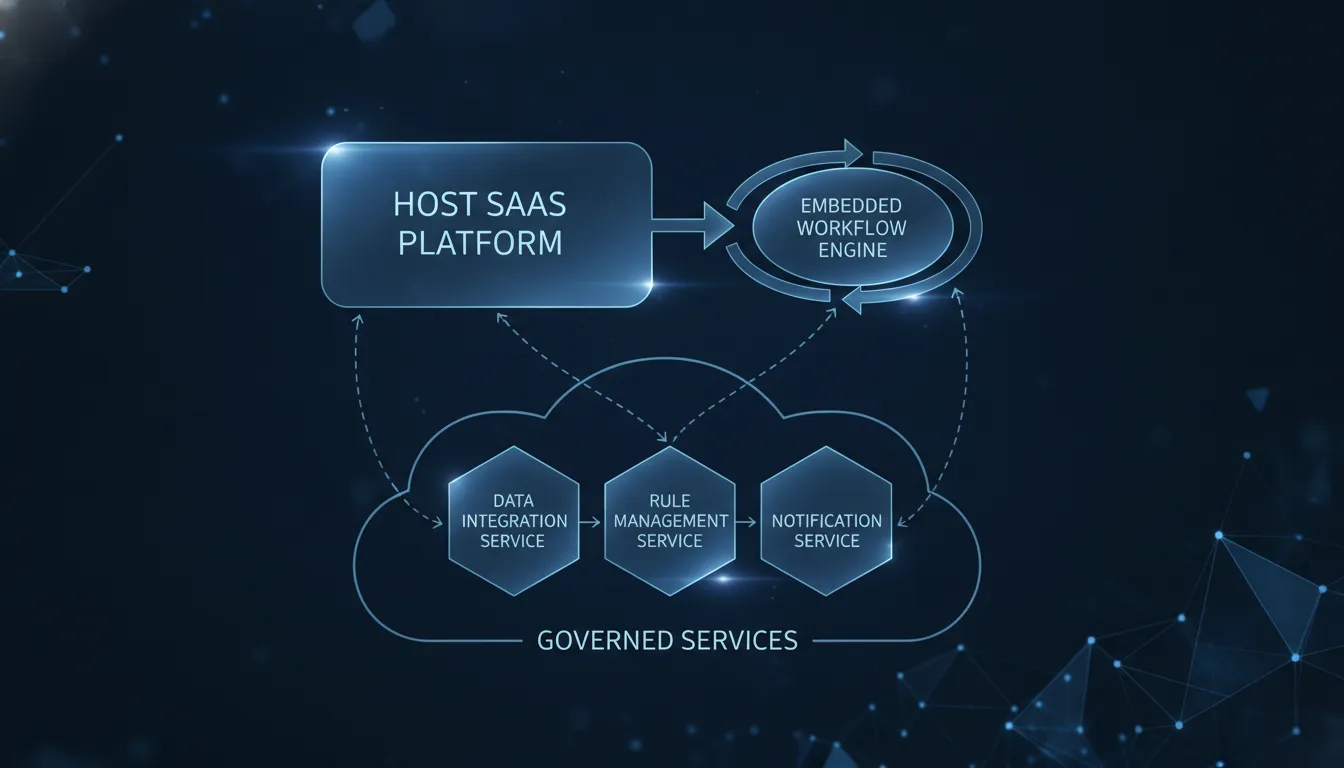
An embedded workflow engine executes within the host product's architecture. It can use established identity, data-access, observability, and deployment controls while avoiding the latency and failure modes introduced by a separately operated orchestration service.
That proximity gives architects explicit control over transaction boundaries, process state, exception handling, and integration behavior. The engine remains modular, but its runtime behavior aligns with the host application's security and operational model.
Reduced delivery scope
A mature engine removes an extensive platform backlog from the product roadmap. Engineering teams integrate and extend proven orchestration capabilities rather than designing execution semantics, visual tooling, version management, audit services, and recovery behavior independently.
This changes time to market without surrendering product differentiation. Teams retain control of domain logic and user experience while relying on a tested runtime for durable process execution.
Predictable lifecycle ownership
A custom engine creates a permanent product surface that requires defect remediation, security updates, compatibility work, performance testing, and feature development. Those obligations compete directly with customer-facing roadmap priorities.
Buying shifts much of the engine lifecycle to a specialist vendor. FlowWright reports that OEM partners can save up to 90% compared with building equivalent workflow capabilities, primarily by avoiding years of platform engineering and maintenance. CTOs should validate that claim against their own integration scope, licensing model, and operating assumptions.
Build versus buy: where the real trade-offs appear
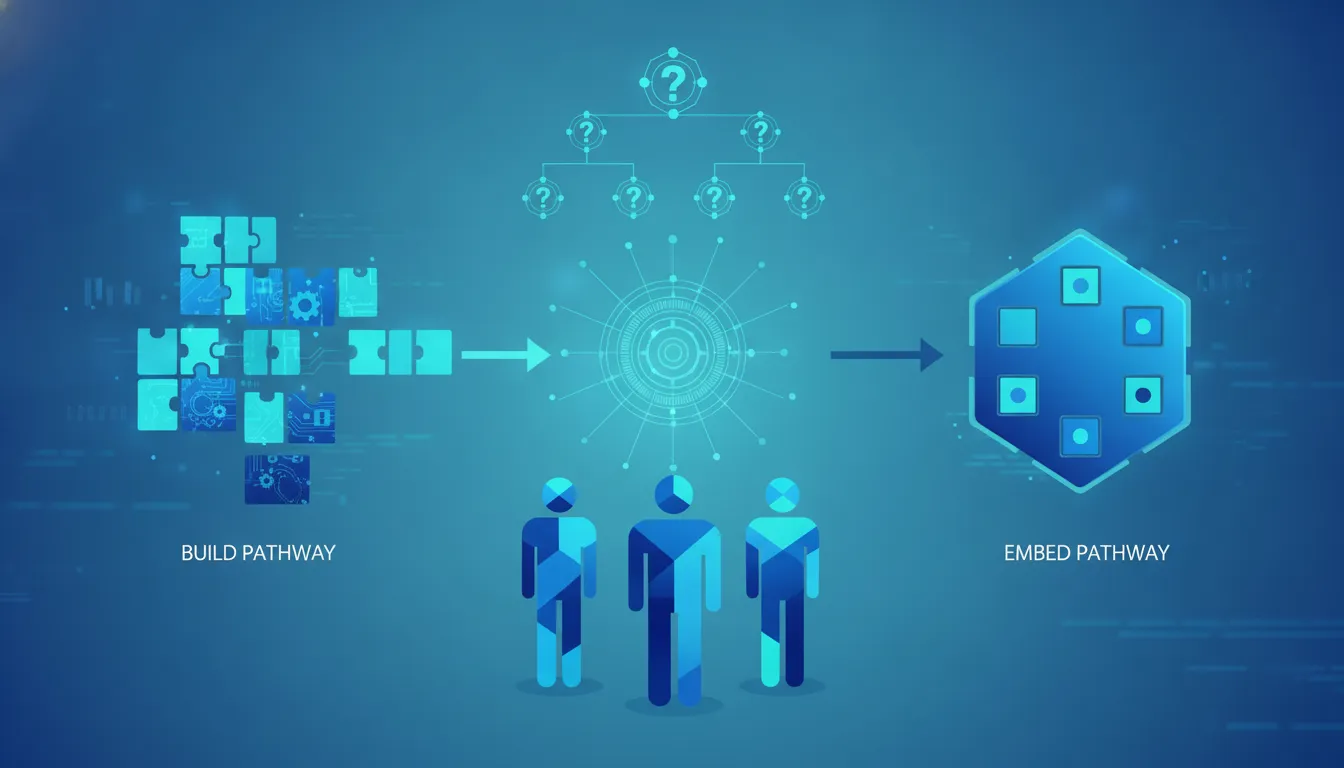
The decision is a comparison between two ownership models. A custom embedded workflow engine maximizes implementation control but makes the product team accountable for every runtime, governance, and tooling capability. Buying narrows internal scope while introducing vendor dependency, commercial commitments, and integration constraints that require due diligence.
Roadmap allocation and differentiation
A custom runtime can be justified when orchestration behavior is the product's primary differentiator or when requirements cannot be met through supported extension points. Otherwise, engine development consumes specialists who could be delivering differentiated product capabilities.
Operational accountability
With a custom engine, the product organization owns incident response, security remediation, backward compatibility, capacity planning, and recovery testing. A vendor-supported engine shares that responsibility, but the buyer must verify support boundaries, release practices, escalation paths, and deployment options.
Delivery economics
Building an engine establishes a separate platform workstream whose scope extends well beyond initial execution logic. Buying reduces that scope to architecture validation, integration, extension, and governance. FlowWright reports that OEM partners can save up to 90% compared with building equivalent workflow capabilities; use a proof of concept and total-cost model to validate the expected result for your environment.
| Feature. | Build Custom. | Buy Embedded. |
|---|---|---|
| Product roadmap. | Competes with core feature work. | Reduces engine development scope. |
| Initial work. | Internal design and development. | Integration and configuration. |
| Upkeep. | Full internal burden. | Engine upkeep handled by vendor. |
| Security. | Owned by the product team. | Shared with the vendor. |
| Customization. | Full control with full ownership. | API and SDK support. |
| Scaling. | Designed and tested internally. | Mature distributed architecture. |
Control, resilience, and scale
Architecture review should establish throughput, concurrency, recovery-point, and recovery-time requirements before comparing engines. Mature runtimes may provide horizontal execution, failover, workload isolation, and operational telemetry, but each capability must be tested under representative workloads and failure scenarios.
Enterprise readiness also depends on capabilities beyond runtime scale:
- Immutable, queryable audit histories for process and configuration changes.
- Governed low-code tools with role-based authoring and approval controls.
- Visual designers that support complex branching, exception paths, and versioning.
These capabilities let domain teams configure processes without bypassing architecture, security, or release governance.
Why building a workflow engine becomes a long-term job
An initial orchestration component often handles only state transitions and task dispatch. Production requirements expand the scope into durable state, retries, idempotency, version migration, authoring tools, observability, access control, auditability, and recovery. The result is a platform with its own roadmap and operating model.
Compounding platform debt
Each new process pattern creates runtime and tooling requirements. Visual modeling, reusable components, testing, debugging, and controlled deployment are not optional once business users and multiple product teams depend on the engine. Underinvestment produces brittle workflows; continued investment diverts engineering capacity from the core product.
A NIST study of software testing infrastructure illustrates the broader cost impact of inadequate testing practices. For a workflow platform, lifecycle cost should include dedicated quality engineering, compatibility validation, and operational support.
Versioning and operability
Long-running instances may remain active across multiple releases. The engine therefore needs explicit version semantics, migration policies, backward compatibility, and safe deployment controls. Teams must also instrument execution latency, queue depth, failures, retries, and process-level service objectives.
Without those controls, operators cannot diagnose incidents or deploy changes safely. A mature engine can provide the runtime telemetry and administration surfaces required to manage this lifecycle.
Governance, security, and auditability
Enterprise workflows require attributable changes, tamper-resistant audit histories, role-based authorization, secrets management, and policy enforcement. Regulated environments may also require retention controls, evidence export, and separation of duties.
These controls must cover both workflow execution and design-time administration. Whether built or bought, the engine should integrate with the product's identity, security monitoring, and compliance evidence processes.
How should a software team evaluate an embedded workflow engine?
Evaluate an embedded workflow engine against the product's target architecture, operating model, and customer commitments. The assessment should expose lifecycle ownership and integration risk, not simply compare feature lists.
Define process and operating requirements
Document process complexity, expected concurrency, human-task patterns, service objectives, authoring personas, governance controls, and regulatory obligations. Distinguish mandatory runtime capabilities from convenience features, then test both under representative workloads.
Validate architecture and data fit
An embeddable engine should integrate with the application's identity, data, observability, and deployment architecture. .NET teams should validate native runtime compatibility, supported persistence options, transaction behavior, upgrade procedures, and whether process definitions can be deployed without disrupting active instances.
- Map process patterns. Inventory workflows, branching complexity, long-running instances, human tasks, integration points, and failure handling.
- Review the target architecture. Verify runtime, hosting, identity, persistence, observability, and deployment compatibility.
- Assess multi-tenancy. Test tenant isolation across execution data, definitions, administration, and operational telemetry.
- Test extension points. Implement representative custom steps and integrations through supported APIs and SDKs.
- Verify governance. Confirm audit evidence, authorization boundaries, version controls, and separation of duties.
- Run a proof of concept. Measure integration effort, performance, failure recovery, upgrades, and operational support using realistic scenarios.
Model long-term ownership
Compare total lifecycle responsibilities over a multi-year horizon. Include platform engineering, quality assurance, security remediation, infrastructure, support, upgrades, compatibility testing, and opportunity cost. For a purchased engine, also assess vendor viability, release cadence, support commitments, data portability, and exit options.
What should .NET teams look for?
For a .NET product, an embedded workflow engine should align with the existing runtime, hosting topology, dependency-management practices, and operational standards. Native integration can reduce network overhead, but architects must still evaluate resource isolation, failure containment, and upgrade compatibility.
Native runtime and supported SDKs
Assess the engine's .NET APIs, dependency model, asynchronous execution semantics, authentication integration, and support for custom activities. Confirm that persistence options, transaction boundaries, and telemetry integrate cleanly with the product's established architecture.
Extensibility and distributed execution
Implement representative domain-specific activities through the supported SDK, then test deployment, versioning, debugging, and supportability. For high-scale environments, verify horizontal execution, failover behavior, workload partitioning, and zero-downtime process-definition changes under realistic conditions.
How do multi-tenancy and white-labeling change the decision?
Multi-tenancy expands an embeddable workflow engine's security and governance boundary. The evaluation must cover isolation of runtime data, process definitions, credentials, administration, telemetry, and resource consumption. White-labeling adds requirements for composable user interfaces and consistent product-level identity.
Enforce tenant isolation
Verify tenant context propagation across every execution path, integration, queue, log, and administrative action. Test authorization failures and noisy-neighbor scenarios, and establish whether isolation is logical, physical, or configurable by deployment tier.
Preserve a unified product experience
A white-label engine should let the host product control navigation, identity, terminology, visual design, and authorization. Embedded designers and administration surfaces should feel native while retaining governed access to the underlying workflow capabilities.
Scale upgrades safely
Multi-tenant upgrades require backward-compatible process execution, controlled definition rollout, tenant-specific configuration, and rollback procedures. Validate how engine releases affect active instances and how operational changes can be introduced without cross-tenant disruption.
When does buying make more sense than building?
Buying is generally the stronger option when workflow orchestration is necessary infrastructure rather than the product's primary differentiator, and when a vendor can satisfy architecture, governance, extensibility, and deployment requirements without unacceptable dependency risk.
Protect differentiated roadmap capacity
Engineering capacity should remain concentrated on capabilities customers uniquely associate with the product. If the internal engine roadmap is dominated by standard platform concerns such as retries, versioning, visual design, audit, and administration, purchasing can materially improve roadmap focus.
Reduce lifecycle exposure
A mature engine can reduce the internal burden of compatibility, security remediation, runtime enhancement, and support tooling. The trade-off is vendor dependency, which should be managed through architecture review, support commitments, upgrade testing, and documented exit options.
Satisfy enterprise operating requirements
Buying is compelling when the product needs distributed execution, failover, governed low-code authoring, audit evidence, and enterprise integrations sooner than an internal platform team can deliver and validate them. A proof of concept should demonstrate these capabilities against explicit service objectives and failure scenarios.
Frequently Asked Questions
What is the difference between an embedded and a remote workflow engine?
An embedded engine executes within the host product's architecture and can share its identity, data, deployment, and observability controls. A remote engine operates as a separately deployed service, introducing network boundaries, independent scaling, and additional operational dependencies.
Can you build an embedded workflow engine from scratch?
Yes. Building one is justified when proprietary orchestration behavior creates strategic differentiation. The product team must also own durable execution, retries, versioning, auditability, authoring tools, security, observability, upgrades, and long-term support.
How do I embed a workflow engine in a .NET application?
Add the supported .NET libraries, configure persistence and runtime services, integrate identity and telemetry, and implement domain-specific activities through the SDK. Validate transaction behavior, failure recovery, version deployment, and resource consumption before production rollout.
Does an embedded workflow engine support different databases?
Database support depends on the engine. Evaluate supported SQL and NoSQL providers, consistency guarantees, transaction semantics, migration tooling, tenant isolation, backup procedures, and operational limits against the product's data architecture.
Why would you choose an embedded workflow engine?
Choose an embedded engine when the product needs governed workflow capabilities without operating a separate orchestration service or building an entire workflow platform. It can reduce delivery scope while preserving control over domain logic, user experience, deployment, and integrations.
Ready to evaluate an embedded engine?
A structured build-versus-buy review should quantify platform ownership, architecture fit, governance requirements, integration effort, and lifecycle risk. Use a representative proof of concept to validate FlowWright against your product's technical and operational requirements.
Request a demo to review the architecture and define a proof of concept for your product.