
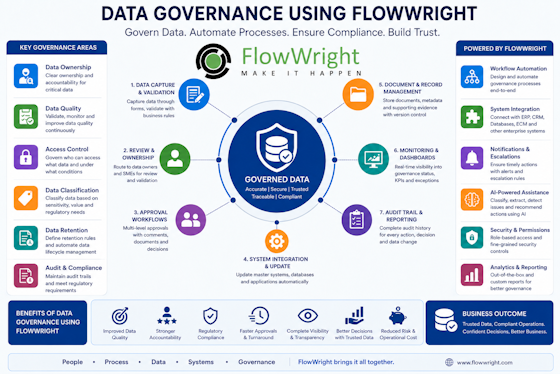
Data is now one of the most important assets inside every organization. It drives decisions, feeds analytics, supports AI models, proves compliance, and connects business operations across departments. But as data grows across systems, teams, documents, workflows, and databases, governance becomes harder.
Most organizations do not fail at data governance because they lack policies. They fail because policies are not connected to daily execution.
A company may define rules for data ownership, approval, retention, validation, access, audit, and reporting. But if those rules are buried in documents, spreadsheets, email threads, or disconnected systems, they are difficult to enforce. Data governance becomes manual, inconsistent, and reactive.
FlowWright solves this by turning data governance into executable business processes.
Instead of treating data governance as a static policy framework, FlowWright allows organizations to design, automate, monitor, and audit governance processes across people, systems, documents, and data sources.
What Is Data Governance?
Data governance is the discipline of managing data so that it is accurate, secure, trusted, traceable, and used correctly across the organization.
A strong data governance program normally includes:
- Data ownership
- Data quality rules
- Data access control
- Data classification
- Data approval workflows
- Data change management
- Data retention policies
- Audit trails
- Regulatory compliance
- Exception handling
- Reporting and accountability
For example, when a customer record is created or modified, governance should answer several questions:
Who created the record?
Was the data validated?
Was the change approved?
Which system received the update?
Was sensitive data protected?
Who has access to it?
Can the organization prove what happened later?
Without workflow automation, answering these questions usually requires manual investigation across logs, emails, spreadsheets, and application databases.
With FlowWright, these governance activities can become structured, repeatable, and auditable workflows.
Why Traditional Data Governance Falls Short
Many organizations start data governance with committees, spreadsheets, policies, and manual review meetings. This may work at a small scale, but it breaks down as the organization grows.
The common problems are:
Data ownership is unclear. Teams may not know who is responsible for approving, correcting, or maintaining specific data.
Data quality issues are handled manually. Errors are reported by email, assigned informally, and resolved without consistent tracking.
Approvals happen outside the system. Critical data changes may be approved through email or chat, making auditability weak.
Compliance evidence is hard to gather. During audits, teams must manually collect screenshots, logs, approvals, and documents.
Data changes are not controlled. Updates to master data, supplier data, customer data, employee data, or regulated documents may happen without a governed process.
Security decisions are disconnected. Access requests and permission changes may not follow a consistent approval path.
FlowWright addresses these problems by connecting governance rules directly to automated processes.
FlowWright as a Data Governance Automation Platform
FlowWright provides a process-driven foundation for data governance. It allows organizations to define how data should move, who should approve it, what rules should validate it, what systems should be updated, and what audit history should be captured.
Instead of relying on users to remember governance policies, FlowWright enforces them through workflows.
A governance process in FlowWright can include:
- Form-based data collection
- Rule-based validation
- Human approvals
- AI-assisted classification or extraction
- Integration with external systems
- Document generation
- Notifications and escalations
- Audit tracking
- Exception handling
- Dashboards and reporting
This makes FlowWright especially useful for organizations that need strong control over operational data, regulatory data, process data, and document-based data.
Governing Data at the Point of Entry
Good governance starts when data enters the organization.
If bad data is captured at the beginning, every downstream process is affected. Reports become unreliable. AI models produce poor results. Compliance risk increases. Employees lose trust in systems.
FlowWright helps govern data at the point of entry using forms, validation rules, required fields, dropdowns, conditional logic, and workflow-driven review.
For example, a supplier onboarding process can require:
- Supplier legal name
- Tax identification number
- Insurance documents
- Banking information
- Risk classification
- Compliance certifications
- Approval from procurement
- Approval from finance
- Approval from legal
FlowWright can validate required fields, route the request for review, capture approvals, store supporting documents, and update downstream systems only after governance requirements are met.
This prevents uncontrolled data creation and ensures that new records are complete, validated, and approved before they become official.
Data Ownership and Accountability
A major part of data governance is accountability. Every important data domain should have clear owners and reviewers.
FlowWright allows governance processes to assign tasks to specific users, roles, or groups. This makes responsibility visible and enforceable.
For example, customer master data changes may follow this pattern:
- A sales operations user submits a customer data update.
- The system validates required fields.
- The data owner reviews the change.
- Finance approves billing-related changes.
- Compliance reviews sensitive classifications.
- The approved update is pushed to the CRM or ERP.
- The full history is stored for audit.
FlowWright ensures that each person receives the right task at the right time. If someone does not act, escalation rules can notify managers or reassign the task.
This turns data ownership from a theoretical concept into an operational reality.
Data Quality Management
Data quality is not a one-time activity. It requires continuous monitoring, correction, approval, and verification.
FlowWright can support data quality management by automating issue detection and remediation workflows.
For example, a data quality rule may detect:
- Missing customer addresses
- Duplicate supplier records
- Expired compliance documents
- Invalid product codes
- Incomplete employee records
- Unapproved pricing changes
- Documents missing required metadata
When an issue is detected, FlowWright can automatically create a workflow instance, assign the issue to the right owner, collect corrections, validate the updated data, and close the issue only after approval.
This gives organizations a governed process for fixing data problems instead of relying on informal email communication.
A simple example is duplicate supplier cleanup. FlowWright can route the duplicate record to procurement, request confirmation, collect supporting evidence, approve the merge, update the supplier system, and record the decision history.
Data Classification and Metadata Governance
Organizations need to know what type of data they have before they can govern it properly.
Some data is public. Some is internal. Some is confidential. Some is regulated. Some requires retention controls. Some requires approval before sharing.
FlowWright can help manage data classification by embedding classification steps into business processes.
For documents, records, or submitted forms, FlowWright can require metadata such as:
- Department
- Business process
- Data owner
- Confidentiality level
- Retention category
- Regulatory classification
- Customer or supplier reference
- Document type
- Review frequency
- Approval status
This metadata can then drive downstream workflow behavior.
For example, if a document is marked as regulated, FlowWright can automatically require additional approval, digital signatures, periodic review, and stricter access permissions.
If a data request contains confidential information, FlowWright can route it through security approval before access is granted.
This creates governance that adapts based on data classification.
Access Request Governance
Data governance must also control who can access data.
Access should not be granted casually. It should be requested, reviewed, approved, logged, and periodically revalidated.
FlowWright can automate access request workflows for applications, reports, documents, folders, dashboards, or data sets.
A governed access request process may include:
- User submits access request.
- Manager approves business need.
- Data owner approves data access.
- Security validates the request.
- System grants access.
- FlowWright records the approval trail.
- Access is reviewed periodically.
This helps organizations enforce least privilege access and maintain clear evidence for audits.
For FlowWright’s own enterprise-grade security model, this approach can also apply to process definitions, process instances, forms, dashboards, reports, folders, and documents. Organizations can govern who has access to each operational asset and prove how access decisions were made.
Data Change Management
Uncontrolled data changes are one of the biggest risks in enterprise systems.
A small change to pricing, supplier banking data, product specifications, customer terms, employee records, or compliance classifications can create serious business impact.
FlowWright can govern data changes by requiring structured change request workflows.
For example, a banking information change for a supplier should not be updated directly in the ERP. It should go through a governed workflow:
- Change request is submitted.
- Supporting documentation is attached.
- Supplier identity is verified.
- Procurement reviews the request.
- Finance approves the update.
- Risk checks are performed.
- ERP is updated.
- Audit record is stored.
FlowWright ensures the change follows a controlled process before the master data is updated.
This is especially important in regulated industries such as life sciences, financial services, manufacturing, energy, healthcare, and government.
Governance for Documents and Records
Many governance problems are document-driven.
Policies, SOPs, contracts, validation documents, complaints, CAPAs, deviations, specifications, and audit evidence all require control.
FlowWright can govern documents through workflow-based review, approval, revision control, metadata, permissions, digital signatures, and audit history.
A document governance process can include:
- Document creation
- Metadata classification
- Review routing
- Approval workflow
- Revision control
- Effective date management
- Periodic review
- Obsolete document handling
- Controlled distribution
- Audit history
For example, in life sciences, an SOP may require authoring, quality review, approval, training assignment, effective date control, and periodic review. FlowWright can automate the entire process and maintain a complete governance trail.
This gives organizations stronger control over both structured data and document-based data.
Audit Trails and Compliance Evidence
Governance without evidence is weak governance.
Auditors and regulators do not only ask whether a policy exists. They ask whether it was followed.
FlowWright captures process execution history, task assignments, approvals, decisions, timestamps, comments, escalations, and system actions. This creates a complete operational audit trail.
For a governed data change, FlowWright can show:
- Who submitted the request
- What data was changed
- When it was submitted
- Who reviewed it
- Who approved it
- What comments were entered
- What documents were attached
- What system actions occurred
- Whether exceptions happened
- When the process completed
This reduces the effort required to prepare for audits and improves confidence in compliance reporting.
For organizations dealing with FDA, ISO, SOC, GxP, financial controls, internal audit, or customer compliance requirements, this is critical.
Exception Handling and Escalation
Data governance must handle exceptions. Not every request fits the standard path.
Some data may fail validation. Some approvals may be rejected. Some users may not respond. Some changes may need emergency handling. Some records may require legal review.
FlowWright allows governance processes to include exception paths, escalation rules, timers, notifications, and alternate routing.
For example, if a data quality issue remains unresolved for five business days, FlowWright can escalate it to the data owner’s manager.
If a sensitive data access request is rejected, FlowWright can notify the requester and record the reason.
If a required document is missing, FlowWright can pause the workflow and request additional information.
This makes governance practical because real-world business processes are rarely perfect.
Data Governance Dashboards
Executives and governance teams need visibility.
FlowWright dashboards can provide operational views into governance performance, open tasks, process bottlenecks, exceptions, approvals, and compliance status.
Useful data governance dashboard metrics include:
- Open data change requests
- Pending approvals
- Data quality issues by category
- Average approval cycle time
- Overdue governance tasks
- Access requests by department
- Rejected changes
- Duplicate record issues
- Documents pending review
- Policy exceptions
- Audit readiness status
For example, a data governance manager could view all open supplier data issues, see which department owns each issue, identify overdue items, and drill into the workflow history.
This shifts governance from reactive investigation to proactive management.
AI and Data Governance
AI makes data governance even more important.
AI systems depend on trusted, classified, accurate, and approved data. If governance is weak, AI can amplify bad decisions, expose sensitive information, or generate unreliable outputs.
FlowWright can support AI-driven governance by embedding AI into controlled workflows.
Examples include:
- Classifying incoming documents
- Extracting data from PDFs
- Detecting missing information
- Identifying duplicate records
- Summarizing governance exceptions
- Recommending approval paths
- Flagging unusual data changes
- Generating audit narratives
- Matching documents to business records
The key is that AI should not operate outside governance. With FlowWright, AI can assist the process while humans remain in command.
For example, AI may classify a document as “confidential supplier contract,” extract key metadata, and recommend a retention category. FlowWright can then route the result to a human reviewer before final approval.
This combines automation speed with governance control.
FlowWright as the Governance Layer Across Systems
Most organizations already have many systems: ERP, CRM, HRIS, document repositories, databases, data warehouses, reporting tools, and custom applications.
The problem is that governance often spans across these systems.
FlowWright can act as the governance layer that coordinates work across systems.
For example, a customer data update may start in a portal, require approval from sales operations, update CRM, notify finance, generate an audit record, and trigger downstream reporting updates.
FlowWright can orchestrate this full lifecycle.
This is where workflow-based governance becomes powerful. FlowWright does not need to replace every system. It connects people, systems, documents, and decisions into one governed process.
Example: Governed Master Data Change Process
A practical example is master data change governance.
A user submits a request to change supplier payment information. The request includes supplier ID, new banking details, reason for change, and supporting documentation.
FlowWright validates the form. If required fields are missing, the request cannot move forward.
The workflow routes the request to procurement for business validation. Then it routes to finance for payment risk review. If the supplier is high risk, it routes to compliance. If approved, FlowWright updates the ERP through integration or creates a task for the ERP administrator.
Every decision, comment, attachment, and approval is recorded.
If the request is rejected, FlowWright notifies the requester and records the reason.
This is data governance in action: controlled entry, validation, ownership, approval, security, system update, and auditability.
Benefits of Data Governance Using FlowWright
Using FlowWright for data governance gives organizations several major benefits.
First, it creates consistency. Governance rules are executed the same way every time.
Second, it improves accountability. Every task has an owner, deadline, and history.
Third, it improves compliance. Evidence is captured as part of the process, not reconstructed later.
Fourth, it improves data quality. Issues are routed, corrected, approved, and tracked.
Fifth, it reduces manual work. Email-based approvals and spreadsheet tracking can be replaced with automated workflows.
Sixth, it improves visibility. Dashboards show governance status across processes and teams.
Seventh, it supports AI readiness. Governed data is more reliable for analytics, automation, and AI use cases.
Where FlowWright Fits Best
FlowWright is especially valuable where governance requires both human decisions and system automation.
Strong use cases include:
- Master data change control
- Supplier onboarding
- Customer data updates
- Employee data governance
- Document review and approval
- Compliance evidence collection
- Access request approvals
- Data quality issue management
- Policy exception handling
- Regulatory change management
- AI data review workflows
- Audit response workflows
These are not simple database operations. They are business processes. They involve people, systems, documents, rules, and accountability.
That is where FlowWright adds value.
Final Thoughts
Data governance cannot succeed as a policy document alone. It must become part of daily operations.
FlowWright helps organizations turn governance requirements into executable workflows. It connects data capture, validation, ownership, approval, access control, document management, audit trails, dashboards, integrations, and AI-assisted processing into governed business processes.
The result is stronger data quality, better compliance, clearer accountability, and more trusted operations.
As organizations adopt more automation, analytics, and AI, governed data becomes even more important. FlowWright provides the process automation foundation to manage that governance at enterprise scale.