
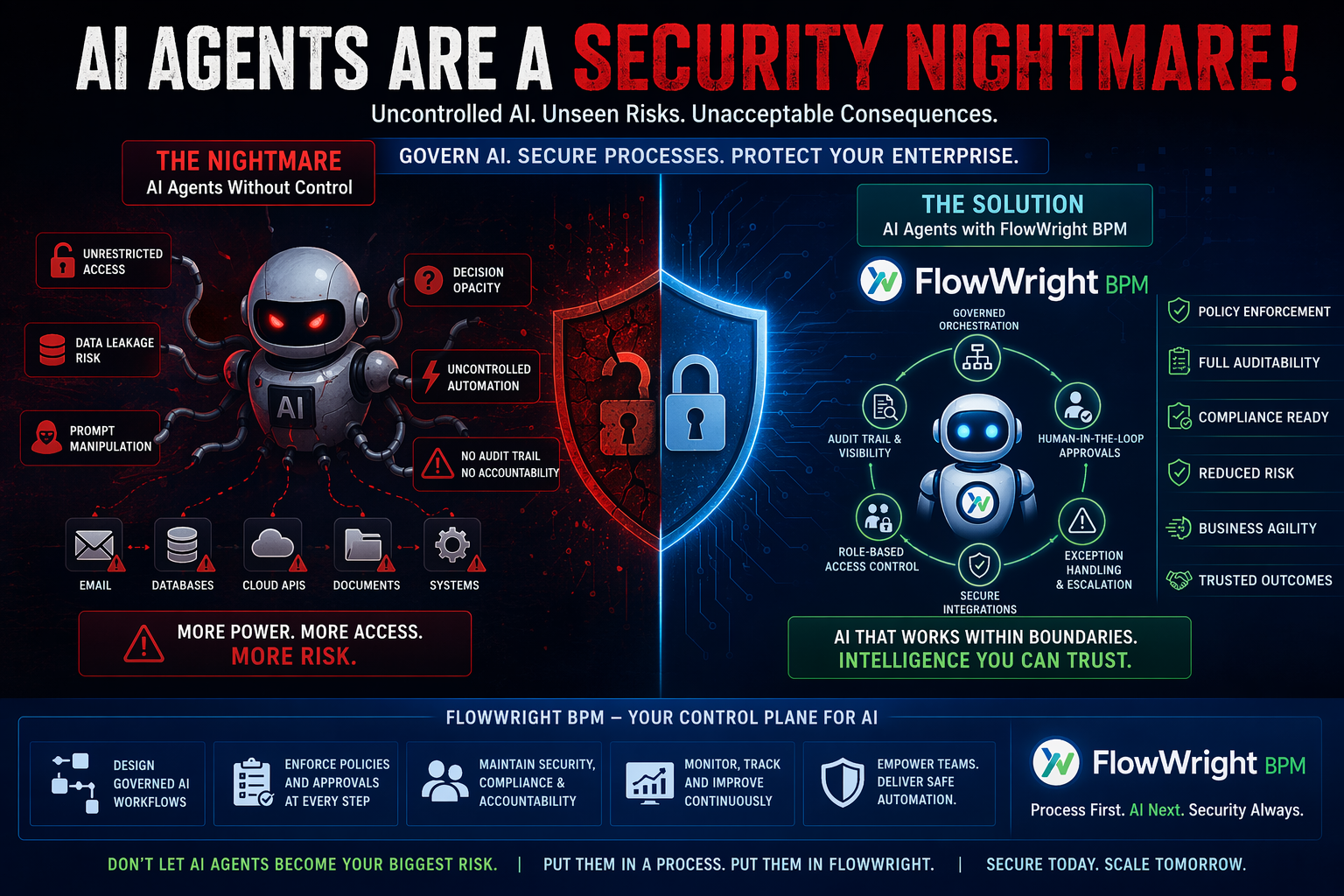
AI agents are the talk of the town, promising to revolutionize how we work. We're told they can make decisions, trigger workflows, and even manage other systems without any human help. It sounds like a massive leap in productivity. The reality? This gold rush often creates a tangled mess of uncontrolled AI integrations. When teams adopt tools on their own, you lose visibility and control. This isn't just messy—it's a major security risk waiting to happen. We need a better way to manage AI before it creates a crisis.
But beneath the excitement is a serious reality that many organizations are only beginning to understand:
AI agents can become a security nightmare.
The more autonomy you give an AI agent, the more risk you introduce into your environment. An agent that can read data, send emails, update records, access APIs, route approvals, or trigger downstream actions is no longer just a chatbot. It is an active participant inside your business operations. And once AI becomes operational, it must be governed like any other powerful enterprise actor.
That is where many organizations get it wrong. They adopt AI agents quickly, but they do not put enough thought into control, oversight, security boundaries, auditability, or process governance. As a result, they create an environment where autonomous intelligence can bypass the very controls the business depends on.
This is exactly why enterprises need a strong Business Process Management platform like FlowWright BPM.
FlowWright BPM gives organizations a structured, secure, and governed way to operationalize AI agents without letting them become uncontrolled security liabilities.
What's the Real Problem with AI Agents?
An AI agent is fundamentally different from a traditional automation script.
A traditional script is deterministic. It follows a fixed set of programmed instructions. It does what it was explicitly told to do. Its behavior is generally predictable.
An AI agent is different because it reasons, interprets, makes choices, and often works across loosely defined objectives. It can decide what actions to take based on context, prompts, available tools, and data it has access to. That flexibility is what makes it powerful. It is also what makes it dangerous.
The moment an AI agent is allowed to interact with enterprise systems, several security concerns emerge.
First, access sprawl becomes a major issue. AI agents often need connections into CRMs, ERPs, document systems, email systems, HR platforms, knowledge bases, and internal APIs. If those access paths are not tightly controlled, the agent can quickly become an overprivileged super-user.
Second, decision opacity becomes a problem. AI systems may take actions based on complex prompt flows, model reasoning, retrieved context, and integrated tools. If an organization cannot clearly explain why the agent made a decision, then incident response, compliance, and governance all become difficult.
Third, data leakage risk increases. If the agent has access to confidential data and is interacting with external models, APIs, or tools, sensitive information can be exposed intentionally or unintentionally.
Fourth, prompt manipulation and malicious input become attack vectors. If an AI agent can be influenced by hostile content, instructions hidden in documents, or crafted user prompts, attackers may be able to redirect the agent’s behavior.
Finally, uncontrolled automation can magnify mistakes at machine speed. A human making one bad decision is a problem. An AI agent making hundreds of bad decisions in seconds is a crisis.
How Uncontrolled AI Puts Your Business at Risk
Most security models in enterprises were built around humans and standard applications. Humans authenticate, receive role-based permissions, and operate within known interfaces. Traditional applications have fixed logic, tested boundaries, and clearly defined behavior.
AI agents do not fit neatly into this model.
They are dynamic. They may invoke tools, chain actions, choose alternate paths, summarize data, generate outputs, and trigger downstream events. In many cases, they behave like a hybrid of user, integration layer, and decision engine all at once.
That creates serious questions:
Who approved the agent’s action?
What data was used to reach the decision?
What systems did it touch?
Was the action within policy?
Was a human supposed to review it first?
Did the agent exceed its authority?
Can the action be reversed?
Is there a full audit trail?
Can the organization prove compliance after the fact?
Without a strong operational framework, most companies cannot answer these questions consistently.
That is why dropping AI agents directly into the enterprise without orchestration is dangerous. The issue is not AI itself. The issue is uncontrolled AI operating outside governed business processes.
AI Amplifies Existing Data Security Flaws
Let’s be honest, most organizations have skeletons in their data closets. These are the forgotten folders with loose permissions, old databases that everyone can access, or sensitive information sitting in unsecured locations. For years, these have been latent risks, but AI agents turn them into active threats. As one security expert noted, AI doesn't create new data risks; it makes existing ones much worse. An autonomous agent with broad permissions can scan, find, and act on this poorly secured data at a scale and speed no human ever could. What was once a minor compliance issue becomes a critical security failure waiting to happen, as the agent might inadvertently expose or misuse sensitive data it was never supposed to find.
The Unseen Risk of Employees Using External AI Tools
Your team is smart and resourceful, so it’s no surprise they’re using public AI tools to be more productive. The problem is, they’re often doing it without any oversight, creating a huge blind spot for security and compliance. When an employee pastes proprietary code, a customer support ticket, or an internal strategy document into a public AI chat, that data leaves your control. This is a major risk because, as one discussion on the topic highlighted, AI companies often want to collect data to make their AI better. Your confidential information could be used to train a third-party model, and you have no way to get it back or ensure it’s protected.
Facing New Legal and Compliance Hurdles
The regulatory landscape is scrambling to keep up with artificial intelligence, and the penalties for getting it wrong are severe. New frameworks, most notably the EU AI Act, are establishing strict requirements for how businesses deploy AI. These laws demand transparency, auditability, and clear human oversight for AI-driven decisions. However, as many have pointed out, most companies are not meeting these rules. An uncontrolled AI agent operating without a clear, auditable process trail makes compliance impossible. If you can’t explain why an agent denied a customer’s application or what data it used to make a decision, you are exposed to significant legal and financial risk.
Why AI Without Process Management Is Chaos
Many organizations try to integrate AI agents directly into applications, scripts, or disconnected services. The agent gets wired into email, APIs, documents, or chat interfaces, and suddenly it can act on behalf of the organization.
At first, this looks efficient. Over time, it becomes unmanageable.
Security teams struggle to understand what the agent is doing. Business teams cannot reliably enforce approval chains. Compliance teams cannot trace end-to-end decision history. Developers end up hardcoding guardrails in scattered places. Operations teams have no central visibility.
This is how AI initiatives become fragmented and risky.
AI needs more than intelligence. It needs process boundaries.
It needs step-by-step orchestration.
It needs policy enforcement.
It needs approval checkpoints.
It needs secure integrations.
It needs full visibility.
It needs auditability.
It needs role-based access control.
It needs a governed execution environment.
This is exactly what BPM brings to AI.
The Hidden Costs of Fragmented AI Development
This fragmentation isn't just messy; it creates tangible risks that can quietly undermine your entire operation. When AI agents are developed in silos, they often become overprivileged "super-users" with far too much access to sensitive systems, a problem known as access sprawl. This also introduces a significant risk of data leakage, as confidential information can be unintentionally exposed when an agent interacts with external models or APIs. The most alarming cost, however, is the potential for uncontrolled automation. While a human making a poor decision is a manageable problem, an AI agent making hundreds of bad decisions in seconds can become a full-blown crisis before anyone even notices.
The 10/20/70 Rule: Focusing on What Matters for AI Success
To avoid these pitfalls, it helps to reframe how we think about AI implementation. A useful guideline is the 10/20/70 rule, which suggests how to allocate effort for a successful project. According to this principle, only 10% of your focus should be on the AI algorithms themselves. Another 20% should go toward the underlying technology, data, and infrastructure. The most significant portion—a full 70%—should be dedicated to the people, processes, and change management surrounding the AI. This framework makes it clear that the technology itself is just a small piece of a much larger puzzle.
The Critical 70%: People, Processes, and Change Management
That massive 70% is where AI initiatives truly succeed or fail. It’s about defining the operational guardrails, approval chains, and human oversight that keep AI aligned with business goals. This is the hard work of establishing governance, ensuring compliance, and managing how teams will interact with these new digital workers. If this part isn't handled well, the AI project will almost certainly fail to deliver on its promise, even if the technology is flawless. Without a strong process framework, you’re not just implementing AI; you’re introducing chaos and hoping for the best.
How FlowWright Brings Order to AI
FlowWright BPM provides the missing control layer that AI agents desperately need.
Instead of allowing AI agents to operate as loosely connected autonomous actors, FlowWright places them inside a managed business process. That means every AI-driven action can be defined, constrained, monitored, and audited.
With FlowWright BPM, AI agents do not become rogue actors. They become governed participants in a secure operational framework.
This matters because the enterprise does not just need AI that works. It needs AI that works safely.
1. Orchestrate AI Actions with Full Control
FlowWright lets you define exactly where AI is used in a business process.
An AI agent can classify a document, summarize a case, recommend a next action, generate a response, or extract key data. But it does so within a defined process flow. It does not just act freely across the enterprise.
You can decide:
- when AI is invoked
- what data it receives
- what systems it can call
- what action it is allowed to recommend
- whether a human must approve the result
- what happens if confidence is low
- how exceptions are routed
This turns AI from an uncontrolled automation risk into a managed process step.
2. Add Human Oversight for Key Decisions
One of the biggest mistakes organizations make is assuming AI should operate fully autonomously.
In reality, many high-risk actions should require human review. FlowWright makes this easy by inserting approval tasks, exception handling steps, and escalation paths directly into the workflow.
For example, an AI agent may review a vendor contract and suggest risk flags. But FlowWright can require legal approval before the process moves forward.
An AI agent may draft a response to a customer complaint. But FlowWright can require a manager review before the message is sent.
An AI agent may identify a suspicious transaction. But FlowWright can route it to compliance for validation before any enforcement action occurs.
This is how you reduce security risk without losing AI productivity.
3. Manage Who Can Do What with Role-Based Access
AI agents should never have broad unrestricted access to enterprise resources.
FlowWright helps enforce strong security boundaries by integrating AI actions into role-based process design. Access to forms, tasks, APIs, documents, actions, and data can be controlled through enterprise-grade security models.
Instead of giving the agent universal privileges, you define what is allowed at each stage of the process.
This minimizes blast radius. Even if a model behaves unexpectedly or input is manipulated, the scope of what it can do is constrained by process and security rules.
4. Maintain a Complete Audit Trail of All Activity
Security and compliance teams need visibility.
FlowWright provides a detailed audit trail of process execution. You can track what happened, when it happened, who initiated it, what data was used, what decisions were made, and what downstream actions were triggered.
This is critical for regulated industries and security-conscious enterprises.
When AI participates in a process, organizations need to prove:
- the AI was invoked intentionally
- the decision path followed policy
- approvals were captured
- exceptions were handled correctly
- outcomes were recorded
Without auditability, AI introduces unacceptable operational and compliance risk. With FlowWright, every step is traceable.
5. Handle Exceptions Gracefully with Fallback Plans
AI is not perfect. Models hallucinate. Confidence varies. Inputs can be incomplete. Data can be ambiguous. External AI services can fail.
A secure enterprise design assumes failure will happen and prepares for it.
FlowWright BPM allows organizations to build resilient AI processes with fallback paths, retries, alternate routes, human escalation, and error handling. If the AI agent cannot confidently complete its task, the process can shift to a human queue or alternate business rule path.
That is a huge advantage over ad hoc AI integrations where failures often lead to silent errors, partial actions, or inconsistent outcomes.
6. Unify AI Management with Centralized Governance
FlowWright gives the enterprise a central place to manage AI-enabled processes.
Instead of dozens of disconnected bots and autonomous scripts scattered across departments, organizations can build AI-assisted processes on a unified BPM platform. That means governance becomes practical.
Security teams gain visibility.
Architects gain standardization.
Operations teams gain monitoring.
Compliance teams gain traceability.
Business leaders gain confidence.
This is what mature AI adoption looks like.
Controlled AI in Action: Real-World Examples
Consider a few common scenarios.
Example: Enhancing Customer Service
An AI agent reads inbound emails, determines intent, gathers account details, and proposes a response.
Without BPM, the agent might access too much data, expose sensitive content, or send responses without proper review.
With FlowWright, the process can validate identity, control data access, invoke AI for classification, require approval for specific cases, and log every action.
Example: Securing Financial Operations
An AI agent reviews invoices, flags anomalies, and recommends payment approval.
Without BPM, the agent could approve fraudulent or incorrect payments if input is manipulated or reasoning is flawed.
With FlowWright, payment thresholds, multi-step approvals, segregation of duties, and exception routing can all be enforced before any transaction is finalized.
Example: Automating Regulatory Compliance
An AI agent monitors regulatory updates, summarizes impact, and recommends process changes.
Without BPM, recommendations may be missed, misinterpreted, or applied inconsistently.
With FlowWright, the AI output becomes part of a governed workflow with review, assignment, approval, task tracking, and documented closure.
Why Your AI Needs Guardrails, Not a Blank Check
The wrong way to think about enterprise AI is to ask, “How do we make the agent do more?”
The right question is, “How do we make the agent act safely, predictably, and under control?”
That requires guardrails.
Not superficial prompt guardrails.
Not just model filters.
Not scattered API checks.
Real operational guardrails.
FlowWright BPM provides those guardrails by embedding AI into secure, orchestrated, policy-driven workflows.
This is how enterprises can embrace AI without surrendering security.
FlowWright: The Control Plane for Responsible AI
The future of enterprise automation is not humans versus AI. It is humans, AI, and business processes working together.
AI agents bring speed, intelligence, and adaptability.
Humans bring judgment, accountability, and oversight.
FlowWright BPM brings structure, governance, and security.
That combination is powerful.
It means organizations can deploy AI agents for real business value while still maintaining enterprise standards for control, compliance, and security.
Instead of letting AI roam freely across systems, FlowWright turns AI into a managed capability inside a trusted process architecture.
That is the difference between innovation and exposure.
AI agents are not inherently bad. They are powerful. But power without governance is dangerous.
When AI agents are deployed without control, they create security gaps, compliance risks, data exposure issues, and operational uncertainty. They can act too broadly, too quickly, and with too little visibility.
That is why enterprises should not deploy AI agents as standalone actors.
They should deploy them within a BPM platform that provides orchestration, security, visibility, human oversight, and auditability.
AI agents may be a security nightmare on their own. But with FlowWright BPM, they become secure, governable, and enterprise-ready.
That is the real path forward.
Not uncontrolled autonomy.
Not blind trust in AI.
But intelligent automation, running inside a process framework designed for the enterprise.
And that is exactly why you need FlowWright BPM.
Frequently Asked Questions
Why can't I just let my AI agents run freely? Isn't autonomy the whole point? That’s a great question because it gets to the heart of the issue. Think of it this way: autonomy in a business setting doesn't mean a lack of rules, it means having the freedom to operate effectively within safe boundaries. An AI agent with no constraints is like a new hire with a key to every system in your company on their first day. A process management platform like FlowWright provides the necessary structure, defining exactly what the agent can and can't do. This ensures its powerful capabilities are used for productive work, not for creating security holes.
My employees are just using public AI chatbots for simple tasks. What's the harm? The harm is often hidden until it's too late. When an employee pastes anything into a public AI tool, whether it's a piece of code, a customer email, or an internal memo, that data leaves your control. You no longer have any say in how it's stored, used, or protected. Many AI companies use that data to train their models, which means your confidential information could become part of their product. Using a governed platform keeps your sensitive data secure within your own environment.
We have skilled developers. Can't we just code our own security rules around our AI agents? You certainly could, but it often creates more problems than it solves. When you build custom security rules for each individual AI agent, you end up with a fragmented and brittle system that's difficult to manage and audit. A BPM platform provides a centralized framework for all your AI-driven processes. This gives your security and compliance teams a single, clear view of what's happening, and it allows your developers to focus on innovation instead of constantly reinventing security protocols.
Does putting AI inside a process management tool mean a human has to approve every single action? Not at all. The goal is to apply oversight where it matters most, not to create bottlenecks. A flexible BPM platform allows you to design smart workflows. You can configure it so that AI handles routine, low-risk tasks completely on its own, while automatically routing high-risk decisions, or those with low-confidence scores, to a person for review. It’s about implementing strategic control, not requiring manual approval for everything.
What happens if the AI makes a mistake or an external AI service goes down? This is where a process-driven approach really shines. AI isn't perfect, and services can fail. If your AI is just a standalone script, an error can cause the process to break silently, leaving tasks incomplete. With a BPM platform, you can build in fallback plans from the start. If an AI gives a strange answer or an API call fails, the process can automatically reroute the task to a human, try an alternate path, or log the error for investigation. This makes your operations resilient and ensures business continues, even when the technology has a hiccup.
Key Takeaways
- Govern your AI agents to prevent security risks: Without clear rules and oversight, AI agents can create major security gaps through uncontrolled data access and automated errors. Treat them as powerful operational tools that require strict management, not as simple assistants.
- Prioritize process for successful AI adoption: The technology is only a small part of the equation; true success comes from building a strong operational framework around your AI. This means defining clear processes, establishing human review checkpoints, and managing how your teams interact with new AI capabilities.
- Use a BPM platform for complete control and visibility: A Business Process Management (BPM) platform acts as the essential control layer for enterprise AI. By embedding agents into managed workflows, you can orchestrate their actions, enforce approvals, and maintain a full audit trail, turning a potential risk into a secure, compliant asset.