For years, we've been heads-down, focused on digitizing our businesses. We automated approvals, connected our systems, and built a solid foundation for efficiency. That was crucial work, but it's no longer the end game. The conversation is shifting to something bigger: building a true AI Agentic Enterprise. This isn't just about AI that answers questions. We're talking about smart agents that observe, reason, and take action—all while collaborating with us. They can trigger actions across systems and keep work moving forward, creating a massive leap in what's possible.
This is where FlowWright becomes extremely important.
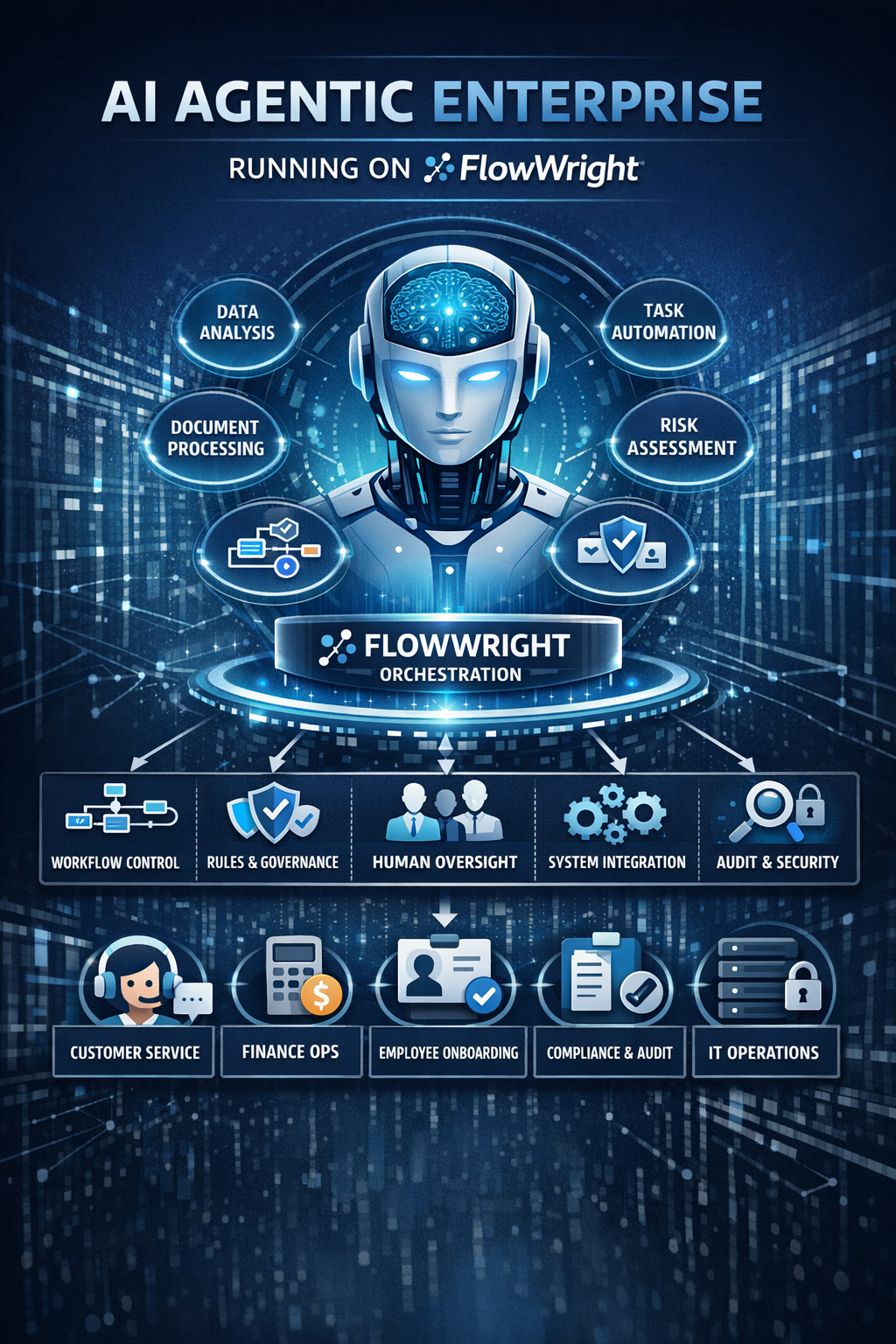
FlowWright is not just a workflow platform that automates tasks. It is the orchestration layer that allows an enterprise to safely operationalize AI agents. In an agentic enterprise, intelligence without control becomes risk. Automation without adaptability becomes brittle. FlowWright bridges those two worlds by combining structured process orchestration, human oversight, data movement, rules, integrations, and AI-driven decisioning into one enterprise-grade execution model.
An AI agentic enterprise running on FlowWright is one where AI is embedded inside business execution, not bolted on as a side feature.
What is an AI Agentic Enterprise?
An agentic enterprise is an organization where software agents actively participate in day-to-day operations. These agents can:
- monitor business events
- gather information from multiple systems
- evaluate context
- recommend or take actions
- collaborate with people
- escalate when confidence is low
- learn from outcomes
- continue execution until objectives are completed
Unlike traditional bots or static automation, AI agents are dynamic. They can interpret intent, work with unstructured content, interact with APIs, and adapt to changing conditions. But enterprises cannot allow unconstrained AI to run core operations on its own. A real enterprise platform must provide governance, visibility, auditability, role-based access, exception handling, and deterministic control.
That is why the agentic enterprise needs a platform like FlowWright.
The Business Impact of an AI Agentic Enterprise
Adopting an agentic model isn't just a technical upgrade; it's a fundamental shift that delivers measurable results across the organization. When AI agents are woven into the fabric of your operations, they don't just automate tasks—they accelerate outcomes, improve experiences, and create a more resilient business. This transformation touches everything from internal productivity to customer satisfaction. The key is having a central nervous system to manage it all. An AI-powered platform like FlowWright provides the necessary orchestration to ensure these agents operate securely and efficiently, turning potential into performance.
Boosting Efficiency and Productivity
One of the most immediate impacts of an agentic enterprise is a dramatic increase in operational speed and accuracy. AI agents can make business tasks between 30% and 50% faster by taking over the manual, repetitive work that consumes employee time. Think about processes like data entry, report generation, or system monitoring. Agents can execute these duties around the clock with fewer errors, reducing the amount of tedious work for your team by up to 40%. This frees up your people to focus on strategic problem-solving and innovation—the high-value work that truly drives the business forward. By using a graphical process designer, you can map out exactly where agents fit into your workflows, ensuring a smooth collaboration between human and digital workers.
Enhancing Customer and Sales Outcomes
Your customers and sales teams also feel the positive effects of an agentic framework. For example, in customer service, AI agents can instantly start customer service requests, gather preliminary information, and even resolve basic issues without human intervention. This leads to significantly faster response times and a more satisfying customer experience. In one instance, an organization saw its claim handling time cut by 40% while its Net Promoter Score (NPS) jumped by 15 points. For sales, agents can handle lead qualification, schedule meetings, and update CRM records, allowing your sales professionals to spend more time building relationships and closing deals. This level of responsiveness and efficiency is what sets leading companies apart.
Market Adoption and Future Projections
The move toward an agentic enterprise is happening now, and early adopters are positioning themselves for a significant competitive advantage. A recent survey found that 35% of companies were already using AI agents in 2023, with another 44% planning to implement them soon. This isn't a distant trend; it's a present-day reality. Companies that build an agentic foundation early will become more agile, innovative, and cost-effective. They can respond to market changes faster, scale operations more easily, and better utilize their employees' unique talents. Establishing a robust process automation and orchestration platform is the critical first step in building this future-ready enterprise and securing long-term growth.
What's the Right Foundation for an AI Agentic Enterprise?
FlowWright provides the exact runtime needed to operationalize AI agents in a controlled enterprise environment. It already understands processes, tasks, forms, decisions, integrations, user roles, document flows, approvals, SLAs, and audit trails. When AI is introduced into this environment, it becomes part of an execution fabric rather than an isolated experiment.
FlowWright enables enterprises to define:
- when an AI agent should start
- what data the agent can access
- what business rules must be enforced
- when human approval is required
- how exceptions are handled
- how every step is logged and audited
- how one agent interacts with other agents, services, and people
This is the key distinction. Many platforms can call an LLM. Far fewer can turn that intelligence into a governed business capability.
Adopting an AI-First Approach
To truly make a change, your organization needs to shift from simply using AI to thinking "AI-first." This isn't about adding a chatbot to your website; it's a fundamental change where you architect your operations to be run and managed by AI, with humans providing oversight and handling exceptions. A recent report from BCG highlights that this requires updating systems, redesigning how work gets done, and developing new skills within your teams. An AI-first approach means embedding intelligent automation at the core of your business. This requires a platform that can orchestrate complex interactions between AI agents, existing applications, and your team members, ensuring every action is governed, secure, and aligned with your business goals.
Connecting Agents to Legacy Systems
One of the biggest hurdles for any large enterprise is the reality of legacy systems. Years of valuable data and critical business logic are often locked away in older applications that weren't designed for the AI era. A full rip-and-replace strategy is rarely feasible or wise. Instead, the most effective path forward is to build a bridge. You can use AI as a "smart middle layer" that connects your new, intelligent agents with these established systems. This allows you to wrap older workflows with modern AI-powered automation, breathing new life into your existing technology investments without disrupting the entire organization. This layer acts as both a translator and an orchestrator between the old and the new.
Using an AI-Powered Middle Layer
This is precisely where a platform like FlowWright provides its greatest value. It serves as that intelligent middle layer, providing the exact runtime needed to operationalize AI agents within a controlled enterprise environment. Because FlowWright already understands the language of business—processes, tasks, forms, decisions, integrations, and user roles—it can seamlessly direct AI agents to perform work within established rules. It provides the essential governance, visibility, and auditability that enterprises demand. By using FlowWright as your integration and orchestration engine, you can ensure that every AI-driven action is controlled, logged, and subject to human approval when necessary, turning powerful AI into a reliable and governed business capability.
Why Agent Orchestration Is the Next Step After Automation
Traditional workflow automation is usually linear. A request enters the system, a set of predefined steps run, approvals happen, integrations fire, and the process completes. This model is still critical, but agentic enterprise systems require something more flexible.
In FlowWright, a process instance can evolve into an intelligent coordinator. It can invoke AI to classify content, interpret requests, generate responses, route tasks, detect risk, update records, and decide the next best action. Instead of hardcoding every possible branch, organizations can combine deterministic process structure with AI-based judgment.
This creates a hybrid operating model:
- Workflow handles structure
- AI handles interpretation
- Rules handle governance
- Humans handle exceptions and accountability
That combination is what makes agentic execution enterprise-ready.
Why Do AI Agents Need Boundaries?
One of the biggest misconceptions around AI agents is that autonomy alone creates value. In enterprise operations, unrestricted autonomy usually creates new risk. Agents need boundaries.
FlowWright gives organizations those boundaries through process design, decision points, permissions, validation, and controlled escalation. An AI agent can be allowed to summarize a contract, extract obligations, and recommend a routing decision. But final approval can still require legal review. An AI agent can detect an invoice anomaly and prepare corrective actions. But releasing payment can remain restricted to authorized finance users.
This matters because enterprises are not looking for random intelligence. They are looking for trusted execution.
FlowWright allows agents to operate inside enterprise policy. That means every AI action can be framed by:
- allowed inputs
- approved outputs
- confidence thresholds
- mandatory validation rules
- approval checkpoints
- role-based permissions
- compliance logging
With this model, AI becomes useful without becoming dangerous.
Designing for Seamless Human-AI Collaboration
The future enterprise is not human-only or AI-only. It is collaborative.
FlowWright is especially powerful here because it already supports structured human work through forms, tasks, dashboards, notifications, escalations, and role-based assignments. AI agents can now participate in that same environment.
For example, an agent can:
- draft a response to a customer complaint
- summarize a policy exception request
- gather supporting evidence from multiple systems
- propose a remediation plan
- prefill a review form for a human analyst
The human then reviews, adjusts, approves, rejects, or escalates. This pattern is far more realistic than claiming that AI will replace enterprise workers outright. In practice, enterprises need AI to reduce cognitive load, accelerate throughput, and improve quality while leaving accountable decisions in the hands of authorized users.
FlowWright makes this collaboration native. The AI does not sit outside the process. It becomes part of the process.
Giving AI Agents a Personality
When we talk about an AI agent's "personality," we're not just talking about a friendly chatbot. We're talking about designing its functional behavior to complement its human teammates. Research shows that when an AI agent's interaction style is designed for effective teamwork, the entire team performs better. For example, one agent might have a "cautious analyst" personality, double-checking data and flagging every potential discrepancy for human review. Another might be a "proactive communicator," designed to summarize progress and send updates without being asked. Within a platform like FlowWright, you can orchestrate how and when these different agent personalities are deployed, ensuring the right AI collaborator is assigned to the right step in a business process to achieve the best possible results.
Building for Emotional Intelligence
Emotional intelligence in AI isn't about the agent having feelings; it's about its ability to understand context and recognize when to hand work off to a person. This is crucial for smooth collaboration. An emotionally intelligent agent knows not to operate in a vacuum. It can draft a response to a complex customer issue, but it also knows to flag it for a human manager's final approval. It can gather supporting evidence from multiple systems for a policy exception but will present it to an analyst for the final, accountable decision. This approach reduces the cognitive load on your team, freeing them from tedious prep work to focus on judgment-based tasks. FlowWright’s platform excels at managing this handoff, creating a seamless workflow where AI assists humans, rather than just automating tasks in isolation.
How AI Agents Streamline Document Workflows
A major opportunity for the agentic enterprise is document-heavy work. Most organizations still depend on documents for onboarding, compliance, claims, contracts, case management, audits, and vendor interactions. Documents are full of business meaning, but historically they have been difficult to automate because the content is semi-structured or unstructured.
FlowWright can turn document handling into an intelligent, agent-driven flow.
An AI agent running inside FlowWright can:
- classify inbound documents
- extract key entities and metadata
- validate required fields
- compare document content against business rules
- identify missing information
- generate follow-up tasks
- route items to the correct teams
- recommend approvals or rejections
- create audit-ready summaries
This transforms document processing from passive storage into active enterprise execution. A document is no longer just uploaded and stored. It becomes the starting point for an intelligent workflow.
How Can Multi-Agent Systems Transform Your Business?
An agentic enterprise does not depend on a single monolithic AI assistant. It often requires specialized agents working together. FlowWright is well suited to orchestrating this model.
Imagine the following multi-agent pattern:
- An intake agent reads an incoming request and identifies the type of business case
- A policy agent checks rules, procedures, and regulatory requirements
- A data agent gathers records from internal systems and external services
- A risk agent scores the request for anomalies or compliance concerns
- A response agent drafts communications or recommended actions
- A workflow coordinator, running on FlowWright, sequences everything, manages checkpoints, and assigns human review where needed
This is where enterprise value appears. The platform is not just calling AI once. It is coordinating intelligent work across multiple actors with clear process control.
FlowWright can serve as the enterprise conductor for these agent interactions.
AI Agents in Action: Real Business Use Cases
The concept becomes clearer when mapped to actual operations.
Reimagining the Customer Experience
A customer email arrives. An AI agent analyzes sentiment, identifies the issue category, pulls transaction history, checks SLA obligations, drafts a response, and routes the case. If the issue is high risk, FlowWright escalates to a supervisor. If it is routine, the process completes faster with minimal manual effort.
Streamlining Your Finance Operations
Invoices arrive from multiple channels. An AI agent extracts invoice data, matches it with POs, detects anomalies, validates tax fields, and starts approval workflows. FlowWright enforces separation of duties, approval hierarchies, and full audit logging.
Automating and Personalizing Employee Onboarding
A new hire request triggers multiple coordinated activities. Agents validate submitted information, generate onboarding documents, provision tasks, answer manager questions, check compliance requirements, and route approvals. FlowWright orchestrates the end-to-end lifecycle across HR, IT, facilities, and security.
Simplifying Compliance and Audit Trails
Regulatory updates are monitored by AI agents. Relevant changes are summarized, mapped to impacted policies or business processes, and routed to compliance teams. FlowWright ensures remediation tasks, review cycles, sign-offs, and traceable evidence collection.
Optimizing IT Service Management
Agents interpret incidents, summarize logs, classify severity, recommend fixes, and gather diagnostic context. FlowWright routes the issue to the correct team, triggers remediation steps, tracks approvals for sensitive changes, and records the full decision history.
Empowering Sales Teams
Sales teams can use AI agents to move beyond manual prospecting and follow-ups. Instead of spending hours sifting through leads, an agent can identify, score, and even initiate contact with potential customers, scheduling meetings directly for sales reps. This frees up your team to focus on building relationships and closing deals. Agentic AI can also handle complex, multi-step tasks like drafting initial contracts or preparing pricing proposals, all while operating within the business rules you define. Companies that adopt this model can respond faster to market changes and gain a significant competitive edge. With an orchestration platform like FlowWright, you can ensure these agents follow approved sales processes, use the correct templates, and log every interaction in your CRM, turning raw intelligence into governed, revenue-driving action.
Enabling Proactive Security
In security operations, AI agents shift the posture from reactive to proactive. An agent can continuously monitor network traffic, user behavior, and system logs to identify anomalies that might signal a threat. However, this power requires strict oversight. An agent might flag a legitimate action as suspicious, and the business must be able to explain every decision made. This is why a process-driven approach is essential. FlowWright provides the guardrails, allowing an agent to detect a potential threat and prepare a response—like isolating a device from the network—but requiring a human security analyst to give the final authorization. This creates a powerful partnership where AI provides speed and scale in detection, while humans maintain control and accountability for the response.
Why Governance Is Critical for AI Agents
As AI becomes embedded into enterprise operations, governance stops being optional. Agentic systems must be explainable enough for business stakeholders, enforceable enough for IT, and auditable enough for security and compliance teams.
FlowWright contributes governance in several important ways:
- process-level visibility into every step
- strong separation between design-time and run-time control
- task and role assignment controls
- deterministic branching where needed
- approval checkpoints
- audit trails across actions and outcomes
- integration with enterprise security models
- configurable exception handling and retries
This means organizations can innovate with AI without losing operational discipline.
In many enterprises, AI pilots fail not because the models are weak, but because the surrounding control framework is missing. A smart answer is not enough. Enterprises need reliable execution. FlowWright provides that execution framework.
A Framework for AI Agent Control
Giving AI agents the freedom to act on your company’s behalf can feel like a huge leap of faith. But it doesn’t have to be. The key is to build a strong framework of control that guides agents, ensures safety, and maintains human oversight. This isn't about stifling innovation; it's about creating a secure environment where AI can deliver real value without introducing unnecessary risk. A comprehensive control framework addresses the entire lifecycle of an agent, from initial concept to daily operation, ensuring that every action is intentional, monitored, and aligned with your business objectives.
Design Phase Controls
Effective control starts long before an AI agent is ever deployed. During the design phase, you must set up clear rules and boundaries that define the agent's purpose and limitations. This means explicitly stating what the agent is supposed to do, what data it can access, and what actions it is permitted to take. Think of it as writing a detailed job description for your digital teammate. By embedding these constraints directly into the agent's core design within a process orchestration platform, you ensure it operates within a predefined "swim lane," preventing it from venturing into unauthorized territory and making decisions it isn't qualified to make.
Build Phase Controls
As you move from design to development, the focus shifts to building in technical safeguards. One of the most critical features is an emergency "kill switch" that allows you to halt an agent's operations instantly if something goes wrong. This prevents a minor error from cascading into a major system-wide problem. It’s also essential to make sure tools are safe by testing agents in a sandboxed environment before they interact with live systems. This build phase is where you stress-test the agent's logic, validate its integrations, and confirm that its safety protocols work as expected, ensuring it's ready for the real world without putting your operations at risk.
Operation Phase Controls
Once an agent is live, continuous monitoring becomes paramount. You can't just "set it and forget it." Instead, people must watch AI agents and have the ability to step in when needed. This is where human-in-the-loop workflows, managed by a platform like FlowWright, are invaluable. Dashboards should provide real-time visibility into agent activities, while comprehensive logs record every decision and the data used to make it. This not only allows for immediate intervention but also creates a detailed audit trail for compliance, troubleshooting, and future performance analysis. This ensures that humans always have the final say and maintain ultimate control over automated processes.
Mitigating Bias and Ensuring Fairness
AI agents are only as good as the data they learn from. If an agent is trained on data that contains historical biases, it can inadvertently make unfair decisions, perpetuating inequalities in areas like hiring, lending, or customer service. To counter this, organizations must be proactive. It starts with carefully auditing training data to identify and remove sources of bias. However, data cleansing alone isn't enough. It's also crucial to implement human review checkpoints for high-stakes decisions. By building processes where an agent makes a recommendation but a person makes the final call, you create a powerful safeguard against algorithmic bias and ensure fairer outcomes for everyone involved.
Establishing Clear Accountability
When an autonomous AI agent makes a mistake, who is responsible? This is a critical question that many organizations struggle with. Without a clear answer, you can create an "accountability vacuum" where it's not always clear who is responsible for the consequences of an agent's actions. The solution is to design for accountability from the outset. By embedding AI agents within a structured business process managed by a platform like FlowWright, you can assign clear ownership for the entire workflow. The platform’s audit trail provides a transparent record of every action taken by both the agent and its human supervisors, ensuring that there is always a clear line of responsibility for every outcome.
Addressing New Security Vulnerabilities
AI agents introduce powerful capabilities, but they also create new security challenges. Because agents are designed to interact with multiple systems and access vast amounts of data, they can become attractive targets for bad actors. A compromised agent could potentially cause widespread disruption or lead to a significant data breach. Therefore, implementing strong security and permission rules is non-negotiable. This means applying the principle of least privilege, granting each agent access only to the specific data and functions it absolutely needs to perform its task. By managing these permissions within a governed workflow environment, you can contain the potential blast radius and ensure your agents enhance your operations without compromising your security posture.
The Operating Model for the AI Agentic Enterprise
The future enterprise will likely be built around a layered operating model.
At the top are business goals and policies. Underneath are processes that define how work should flow. Within those processes are AI agents handling interpretation, recommendations, and content generation. Around everything is governance, security, observability, and human accountability.
FlowWright fits naturally into this model because it already connects business design with technical execution. Business analysts can define workflows and decision logic. Developers can extend the platform with services, APIs, custom integrations, and AI capabilities. Operations teams can monitor execution. Security teams can inspect access and activity. Business leaders can track outcomes through dashboards and reports.
That is the architecture of a real agentic enterprise: not just AI on the screen, but AI woven into the operating fabric.
Managing Employee Adoption and Change
Introducing AI agents is as much a cultural shift as it is a technical one. The most successful transitions happen when employees see AI not as a replacement, but as a collaborator. The future enterprise is a partnership between people and technology, where the goal is to reduce cognitive load and improve quality while leaving accountable decisions in human hands. This approach is far more realistic than suggesting AI will take over jobs entirely. By embedding AI agents within structured workflows, FlowWright ensures that people remain in control. For example, an AI agent can draft a proposal or flag a risk, but it appears as a task for a human to review, approve, or modify. This makes adoption feel like a natural enhancement to their work, not a threat to their role.
Building the Right Skills and Talent
This new collaborative model also calls for a new blend of skills. The most valuable team members will be those who can bridge the gap between business needs and AI capabilities. As you plan how to train employees and redesign roles, remember that getting agentic AI to perform well involves a lot of unseen work, like organizing data and integrating systems. This is where a powerful, low-code platform becomes essential. FlowWright handles much of this underlying complexity, allowing your teams to focus on designing intelligent processes using graphical tools. This approach empowers your existing business and IT experts to build and manage AI-driven workflows without needing deep expertise in machine learning code, turning them into the architects of your agentic enterprise.
How to Implement Agentic Transformation Incrementally
Another advantage of using FlowWright is that enterprises do not need to rebuild everything to become agentic. They can evolve step by step.
A company can start by introducing AI into a single stage of a workflow:
- classify requests
- summarize cases
- generate first drafts
- extract entities from documents
- recommend routing decisions
Then it can expand into more advanced scenarios:
- dynamic next-best-action recommendations
- multi-agent collaboration
- autonomous exception recovery
- intelligent SLA management
- proactive operational monitoring
Because FlowWright already manages the process backbone, enterprises can add agentic capabilities progressively without losing control of core operations.
This reduces risk and accelerates adoption.
What Is an AI Execution Layer (and Why You Need One)?
The biggest takeaway is simple: AI agents need a place to run where business execution, governance, and integration already exist.
FlowWright provides that place.
It allows enterprises to move beyond disconnected AI demos and build operationally meaningful systems where agents participate in real work. It turns AI from a conversational layer into an execution layer. It gives organizations the ability to combine human decisions, rules, workflows, documents, system integrations, and AI reasoning into one coordinated runtime.
An AI agentic enterprise running on FlowWright is not science fiction. It is a practical architecture for organizations that want to scale intelligence safely.
The winners in the next phase of enterprise software will not be the companies that merely adopt AI tools. They will be the ones that embed AI into the core of how work gets done, while preserving control, trust, and accountability.
That is exactly the type of future FlowWright is built to enable.
If your enterprise wants AI agents that do more than chat, if you want agents that execute inside secure, governed, auditable business processes, then the answer is not just more AI. The answer is AI running on FlowWright.
Frequently Asked Questions
Is an "AI agentic enterprise" just a new term for business automation? Not quite. While it includes automation, it's a significant step beyond that. Traditional automation is great at following a fixed set of rules, like a script. An AI agent, on the other hand, can interpret situations, reason through options, and decide on the best course of action, even when things don't go exactly as planned. Think of it as the difference between a player piano that can only play one song and a live musician who can improvise.
We're interested in AI, but a complete overhaul sounds daunting. How can we get started without disrupting everything? That's a very common and smart concern. You don't need to flip a switch overnight. The best approach is to start small and grow from there. Pick a single, high-impact process that involves a lot of manual work, like classifying incoming customer emails or extracting data from invoices. By introducing an AI agent into just that one part of the workflow, you can prove the value, learn, and build momentum before expanding to more complex scenarios.
How do you prevent AI agents from making mistakes or going rogue? Isn't this risky? This is the most important question, and the answer lies in control. Unsupervised AI is indeed a risk, which is why agents should never operate in a vacuum. A platform like FlowWright provides the essential guardrails. You design the process, set the rules, define the permissions, and build in checkpoints where a human must give approval. The agent operates within these boundaries, so it can recommend an action, but a person makes the final, accountable decision for anything critical.
What is the role of our employees if AI agents are doing the work? Your employees become the strategists and decision-makers. Instead of getting bogged down in tedious, repetitive tasks like data gathering or drafting routine responses, your team is freed up to focus on the work that requires human judgment. The AI agent acts as a highly efficient assistant, preparing information, summarizing complex documents, and handling the preliminary steps. This allows your team to work at a higher level, focusing on customer relationships, strategic planning, and handling exceptions.
We already use some AI tools. How is using a platform like FlowWright different? Using standalone AI tools is like having a few brilliant specialists who don't talk to each other. An AI tool might be able to write an email or analyze a document, but that's only one piece of a larger business process. FlowWright acts as the conductor for the entire orchestra. It orchestrates the work between your AI agents, your existing systems, and your people, ensuring everything happens in the right order, according to your business rules, and with a full audit trail. It turns isolated AI capabilities into a fully governed, end-to-end business solution.
Key Takeaways
- Move Beyond Simple Automation: The next step in digital transformation is building an agentic enterprise where AI agents actively reason, act, and collaborate within your business processes, not just automate linear tasks.
- Prioritize Governance for AI Agents: To use AI safely, you need an orchestration platform that provides clear boundaries. This control layer ensures every AI-driven action is governed by business rules, subject to human oversight, and fully auditable, turning potential into reliable performance.
- Design for Human-AI Collaboration: The goal isn't to replace your team; it's to support them. Design workflows where AI agents handle the prep work like data gathering and drafting responses, but humans make the final, accountable decisions.